A dumbbell chest workout without bench support still trains your chest hard, because the floor press, floor fly and push up all load your pecs from the floor, and all you need is a pair of dumbbells.
Table of Contents
Quick Summary
- Core moves: the dumbbell floor press, the floor fly and the push up.
- How often: twice a week with a rest day in between is plenty for beginners. The CDC asks adults for at least 2 days a week of muscle-strengthening activity.
- How hard: pick a weight that tires your muscles in about 12 to 15 reps, according to the Mayo Clinic.
- The trade-off: the floor stops your upper arms, so your range of motion is shorter than on a bench. Research on whether that limits chest growth is inconclusive.
- Do you need a bench? No. An adjustable bench only adds incline options later.
Most guides hand you a list of 12 to 16 exercises, and many of them need an exercise ball. This one sticks to the moves that work with dumbbells and a floor, adds a simple weekly plan and shows what the research does and does not say.
Can You Train Your Chest Without a Bench?
Yes. Your chest muscle (the pectoralis major) works whenever you press weight away from your body or pull it across your torso. A bench is not what trains it. A bench only changes the angle and how far your arms can travel.
Our guide to dumbbell exercises for beginners covers the rest of your body once your chest day is sorted.
Dumbbell Chest Workout Without Bench: The 3 Best Moves
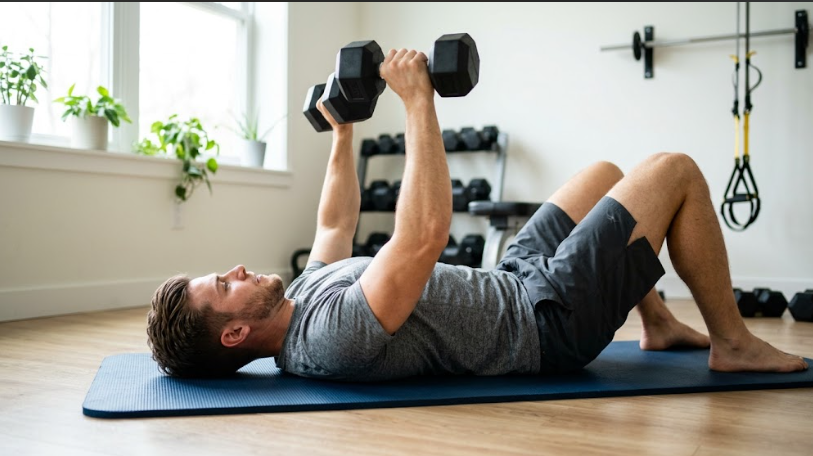
Dumbbell Floor Press
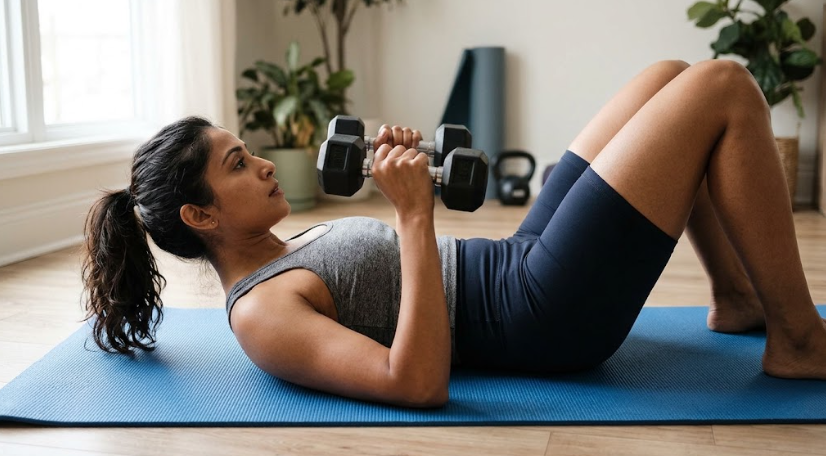
- Sit on the floor with a dumbbell resting on each thigh, then lie back and bring the weights up to your chest. Keep your knees bent and your feet flat.
- Press the dumbbells up until your arms are straight.
- Lower slowly until your upper arms lightly touch the floor, with your elbows about 45 degrees from your body. Do not bounce.
- Press back up.
StrengthLog points out that the floor press limits your range of motion because your upper arms stop against the floor. It is commonly described as easier on the shoulders than a bench press, but we could not find a study that proves it, so treat that as a common observation, not a fact.
Floor Fly
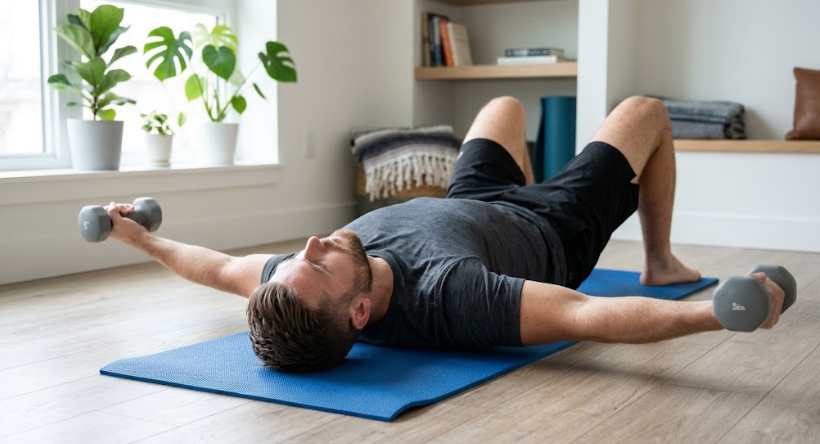
Lie in the same position with the dumbbells over your chest and your palms facing each other. Keep a slight bend in your elbows and open your arms in a wide arc until your upper arms touch the floor. Then squeeze the weights back up along the same arc.
Use much lighter weights than you do for the press. These cues are adapted from the American Council on Exercise’s guidance for the bench version of the fly, which stresses a slight constant elbow bend and neutral wrists. We could not find a certifying-body page for the floor version, so keep the weight light and stop if your shoulders complain.
Push Up
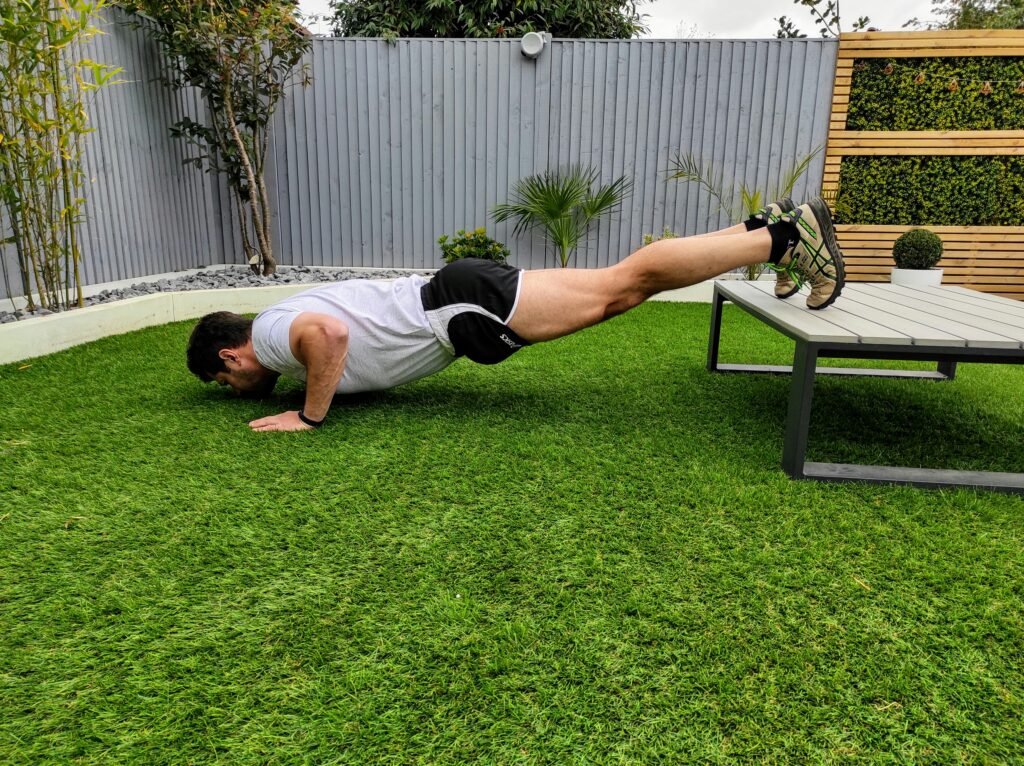
Harvard Health describes the standard push up like this: start in a full plank with your palms just below shoulder level and a straight back, then lower until your elbows reach about 90 degrees. Take about two seconds to go down and one to come up. A push up lifts roughly 50 to 75 percent of your body weight, according to the same source.
If a full push up is too hard, start with wall, incline or knee push ups. The push up ladder in our calisthenics for beginners at home guide shows how to move up one step at a time.
If your wrists hurt, Healthline’s guide to wrist pain in push ups suggests holding push-up handles or dumbbells so your wrists stay straight, and switching to incline versions.
Floor Press vs Bench Press: What Do You Give Up?
The main difference is range of motion. On a bench your elbows can drop below your torso, while on the floor your upper arms stop when they touch it. Some coaches also point out that the floor takes away leg drive and lower-back arch, which keeps the movement strict.
What does that mean for muscle growth? Less than you might think. A 2020 systematic review by Schoenfeld and Grgic looked at how range of motion affects muscle growth. For the upper body it found only two studies with conflicting results, so it could not draw firm conclusions. We cannot say the floor press is worse for your chest, and we cannot say it is just as good.
What the Research Says About Push Ups and Flyes
Push ups can match the bench press for strength. A 2015 randomized trial by Calatayud and colleagues in the Journal of Strength and Conditioning Research compared a 6-rep-max bench press with a band-loaded push up in 30 university students with advanced lifting experience. When muscle activity was comparable, both training groups improved their strength by similar amounts over five weeks, while the control group did not change.
There are limits. The participants were trained, not beginners, the push up was loaded with an elastic band, and the study measured strength, not muscle size. It does show that the push up is a real chest exercise and not only a warm-up.
Flyes are an add-on, not a replacement. A 2020 study by Solstad and colleagues in the Journal of Sports Science and Medicine compared the two in 17 resistance-trained men. Across the whole movement, chest muscle activation was about 16 percent higher in the bench press than in dumbbell flyes. The loads were very different, though (the press used far heavier weight), so the study does not prove one exercise is better than the other. It does support doing a press first and a fly second.
How Many Sets, Reps and Days?
Three trusted sources point the same way:
- CDC: adults should do muscle-strengthening activity on at least 2 days a week that works all the major muscle groups, including the chest.
- Mayo Clinic: choose a weight that tires your muscles in about 12 to 15 reps, and allow one full rest day before working the same muscles again.
- American Council on Exercise: its beginner guidance is 3 sets of 10 to 15 reps, starting at 2 days a week.
So here is a simple dumbbell chest workout without bench support. It is our own beginner starting point, not a clinical program.
| Move | Weeks 1-2 | Weeks 3-4 |
|---|---|---|
| Dumbbell floor press | 2 sets of 10-12 | 3 sets of 10-15 |
| Push up (or an easier version) | 2 sets, stop 2 reps short of failure | 3 sets, stop 2 reps short of failure |
| Floor fly (light) | 2 sets of 10-12 | 2 sets of 12-15 |
Do this twice a week, such as Monday and Thursday. Rest about a minute between sets, or longer if you need it to keep good form. We found no clear beginner rule for rest time, so use what lets you keep clean reps.
Want to fit it into a full week? Our 3-day dumbbell workout schedule for beginners shows how to place a chest day alongside your other training.
How to Pick Your Dumbbell Weight
Use the Mayo Clinic rule: the last two or three reps of each set should feel hard, and you should be able to finish them with good form. If you can easily do more than 15 reps, go heavier. If your form breaks down before 10, go lighter.
Because your needs change as you get stronger, adjustable dumbbells are a practical choice. You change the weight instead of buying a new pair.
Safety Basics
- Warm up first. The Mayo Clinic suggests 5 to 10 minutes of light activity before you lift.
- Check with a doctor if you have a chronic condition, or if you are over 40 and have been inactive.
- Control the dumbbells. Sit with them on your thighs to get into position, and lower them gently to the floor at the end of a set. If a set is heavy, ask a training partner to hand you the weights.
- Keep your wrists straight and your lower back flat. Do not arch your back to push the weight up.
- Keep breathing. Do not hold your breath through the press.
- Stop for sharp pain, and see a healthcare professional if shoulder or elbow pain keeps coming back.
Do You Need a Bench?
No. The floor works well as a starting point. A bench becomes useful later because it adds two things: more range of motion, and incline presses. NASM’s guidance for the incline dumbbell press suggests setting the bench near 45 degrees and keeping your elbows about 45 degrees from your torso.
The popular idea that an incline trains only your “upper chest” is too simple. A 2016 study by Lauver and colleagues in the European Journal of Sport Science tested bench angles in 14 trained men using a barbell. A flat bench worked both the upper and lower chest, while 30 and 45 degree angles raised upper-chest activity only during part of the lift. Angle changes when your chest muscles work, not simply how much.
What You Need for a Dumbbell Chest Day
You need very little. Here is what helps.
- Adjustable dumbbells: one set covers presses, flyes and loaded push ups. Check the listing for the weight range.
- Exercise mat: makes the floor press more comfortable for your back and elbows. Check the listing for thickness.
- Push up bars: they keep your wrists straighter and let you go slightly deeper. Handy if push ups bother your wrists.
- Adjustable bench: optional. It adds incline presses and a longer range of motion. Check the listing for the weight limit and whether it folds.
Common Mistakes
- Bouncing your arms off the floor. Touch lightly and press from a controlled stop.
- Flaring your elbows out to 90 degrees. Keep them about 45 degrees from your torso.
- Using too much weight on flyes. Flyes need light dumbbells.
- Arching your lower back. Keep your back and hips settled on the floor.
- Skipping rest days. Give your chest a day off between sessions.
Quick Answers
Is the floor press good for chest? Yes, it is a solid press that trains your chest and triceps, though your range of motion is shorter than on a bench.
How many times a week should I train chest at home? Twice a week is enough for most beginners, with a rest day in between.
What weight dumbbells should I use? One that tires your muscles in about 12 to 15 reps with good form.
The Bottom Line
A dumbbell chest workout without bench support is simple, cheap and effective for beginners. Use the floor press as your main move, add push ups and a light floor fly, and train twice a week.
Keep your wrists straight, control the weights and add difficulty gradually. A bench can wait until you want incline work.
Disclaimer & Affiliate Disclosure
This article is for informational purposes only and should not be taken as medical advice. Always consult with a qualified healthcare provider or certified fitness professional before starting or changing your diet or exercise routine. This article may also contain affiliate links. If you purchase through these links, we may earn a small commission at no extra cost to you.