Home cardio no equipment is simple to start: pick a few moves like marching, step-ups and jumping jacks, work at a pace where you can talk but not sing, and build up to 150 minutes a week.
Table of Contents
Quick Summary
- How much: the CDC says adults need 150 minutes of moderate activity a week, or 75 minutes of vigorous activity, or an equivalent mix. The WHO range is 150 to 300 minutes moderate or 75 to 150 vigorous.
- How hard: moderate means you can talk but not sing. Vigorous means you can say only a few words before pausing for breath.
- Where to start: 10 minutes, 3 days a week. Build up slowly.
- Short bursts count: a large study found that very short, hard bursts in daily life were linked with a lower risk of death in people who did no workouts.
- Safety: check with a doctor first if you have a health condition or have been inactive, and stop for chest pain, dizziness or breathlessness that does not settle.
Most guides give a long list of moves and stop. This one gives you the official targets, a talk test to set your effort, low-impact and higher-impact options and a simple 4-week plan.
How Much Cardio Do You Need?
Two trusted guidelines are worth knowing. The CDC recommends that adults get at least 150 minutes of moderate-intensity activity a week, or 75 minutes of vigorous activity, or an equal mix. The World Health Organization’s 2020 guidelines give wider ranges: 150 to 300 minutes of moderate activity or 75 to 150 minutes of vigorous activity a week, with extra benefit above that.
Both also recommend muscle-strengthening activity on at least 2 days a week, so cardio is only half of the picture. Our cardio vs weights for fat loss guide explains how the two fit together.
You do not need to reach 150 minutes on day one. The American Heart Association says to not worry if you cannot hit it yet, and that short brisk sessions a few times a day add up.
How Hard Should You Work? The Talk Test

You do not need a heart rate monitor. The CDC and NHS both describe a simple talk test:
- Moderate: you can talk but not sing.
- Vigorous: you can say only a few words before you need a breath.
On a 0 to 10 effort scale, the CDC puts moderate at about 5 or 6 and vigorous at 7 or 8. The American Heart Association also gives heart rate ranges (about 50 to 70 percent of your maximum for moderate), but notes the common “220 minus your age” formula is only an average. For most beginners, the talk test is enough.
Home Cardio No Equipment: Moves to Try
Here are the moves, split by how hard they are on your joints.
Low-impact (no jumping):
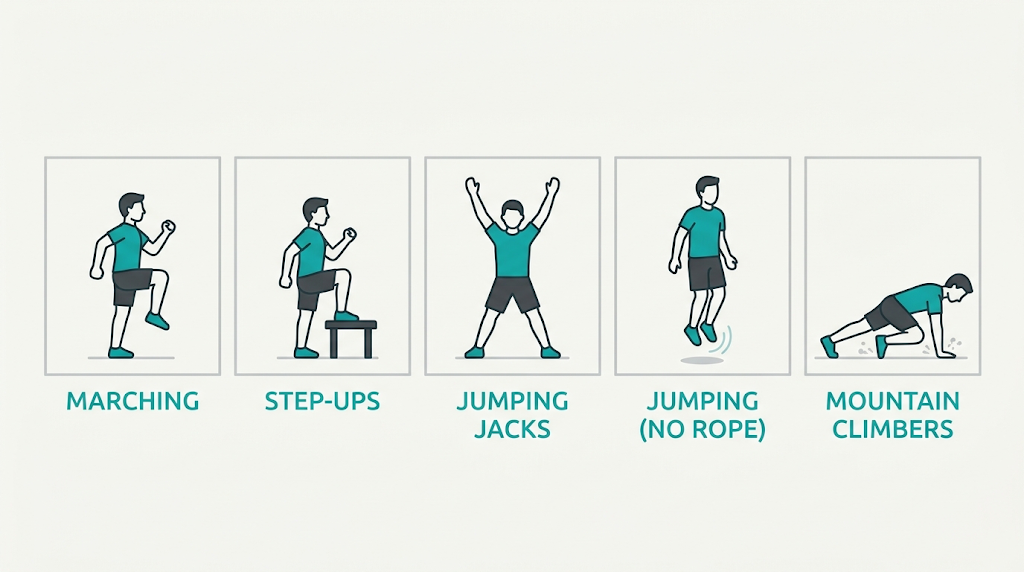
- Marching in place. Harvard Health describes it as standing with your feet together and arms at your sides, swinging your arms and lifting each knee as high as is comfortable. It suggests 30 seconds of marching and 30 seconds of rest as a beginner pattern.
- Step-ups. Use a sturdy step or the bottom stair. Harvard’s step-up guidance says to step up, bring the other foot alongside, and step down in the same order while keeping your torso upright. Do 8 to 10 reps leading with each foot.
Higher-impact (some jumping):
- Jumping jacks, high knees and speed skaters. The American Council on Exercise lists these in its 15-minute cardio drill.
- Jumping rope without a rope. Harvard lists this as a no-equipment option.
- Modified burpees and mountain climbers. ACE’s beginner at-home guide includes both.
For timing, ACE suggests about 30 seconds per move, dropping to 20 if it feels too hard. It also recommends a warm-up of 5 to 10 minutes, a cool-down of at least 5 and three non-consecutive days a week. Allow a clear space of about 6 to 10 feet and wear supportive shoes. Our warm up before a workout guide covers the warm-up.
Quiet options for apartments. No source we found ranks moves by noise, so this part is our own suggestion: marching, step-ups on the bottom stair and low-volume dancing are likely the quietest, while jumping jacks and burpees are the loudest. If you are worried about neighbors, start with the first group.
What the Research Says About Short Bursts
Many guides tell you that you need long sessions. A study suggests otherwise.
The 2022 VILPA study in Nature Medicine by Stamatakis and colleagues followed 25,241 UK adults who reported no leisure-time exercise, using a wrist accelerometer. VILPA stands for vigorous intermittent lifestyle physical activity, meaning very short bursts of hard effort in daily life, such as hurrying up stairs. People who did about 3 bursts a day of 1 to 2 minutes each had a roughly 38 to 40 percent lower risk of dying from any cause than people who did none, over an average of about 7 years.
There are important limits. This was an observational study, so it shows an association, not proof that bursts cause the benefit. The people were older UK volunteers, and the outcome was death, not fitness or weight loss. We read the abstract through the University of Glasgow repository because the journal page would not load.
The practical takeaway is encouraging: short, hard efforts count, so a few minutes of fast stair climbing or jumping jacks is better than nothing.
Your 4-Week Home Cardio No Equipment Plan
This plan is our own starting point, not a clinical program. Work at a talk-but-not-sing pace and rest as needed.
| Week | Sessions | Each session | Notes |
|---|---|---|---|
| 1 | 3 | 10 minutes: 30 seconds march or step-up, 30 seconds rest | Start easy |
| 2 | 3 | 12-15 minutes: add 2 or 3 higher-impact moves | Skip any jumps that hurt |
| 3 | 3-4 | 15-20 minutes, shorter rests | Aim for moderate effort |
| 4 | 3-4 | 20 minutes, with one short hard burst of 20-30 seconds | Add a short brisk walk on other days |
The Mayo Clinic suggests limiting weekly increases to about 10 percent, which is slower than our table, so repeat any week that feels like too much. The American College of Sports Medicine says to start low and go slow, building toward 150 minutes a week over time.
If you want something with an impact, our jump rope workout for beginners plan and our quiet HIIT workout at home routine are good next steps. Walkers can read is walking a form of exercise, and if you want to build lasting stamina, see how to build endurance.
Safe Cardio at Home
- Check with a doctor first if you have a chronic condition, or you have been inactive for a long time. The CDC, Mayo Clinic and NHS all give similar advice.
- Stop for warning signs. The Mayo Clinic lists pain, shortness of breath, dizziness and nausea as reasons to stop and rest.
- Know the heart warning signs. The American Heart Association lists chest pressure or pain, discomfort in the arm, back, neck, jaw or stomach, shortness of breath, cold sweat and nausea. If you feel these, call your local emergency number.
- Go easy on bad knees. A review of 217 trials covered by Harvard Health found lower-impact exercise such as walking, cycling and swimming tended to work best for people with knee osteoarthritis. That applies to people with the condition, not every beginner, but it supports starting with the low-impact moves.
What You Need for Home Cardio
You can start with nothing. These items help.
- Jump rope: a cheap, effective cardio tool once you are ready for some impact. Check the listing for the rope length.
- Exercise mat: cushions the floor for moves like mountain climbers. Check the listing for thickness.
- Running shoes: supportive shoes matter for jumping moves. Check the listing for sizing before you buy.
- Resistance band set: cardio is only half of fitness, and bands cover your strength days.
Common Mistakes
- Starting too hard. Beginners who go all out often quit. Use the talk test.
- Skipping the warm-up. Spend 5 to 10 minutes easing in.
- Jumping on sore knees. Swap in marching or step-ups.
- Doing only cardio. Add strength work on 2 days a week.
- Counting only long sessions. Short bursts add up.
Quick Answers
What is the best home cardio for beginners? Marching in place and step-ups are simple, low-impact places to start.
Can I lose weight with cardio at home? Cardio helps, but weight loss depends mostly on your overall calories. Our guide to how to lose weight fast for beginners explains the basics.
How many days a week should I do cardio? Three days a week is a good start, building toward 150 minutes of moderate activity a week.
Is 10 minutes of cardio worth it? Yes. Short sessions count toward your weekly total.
The Bottom Line
Home cardio no equipment is about picking moves you can do well, working at a talk-but-not-sing pace and building up gradually. Start with marching and step-ups, add a few jumping moves when you are ready and aim for 150 minutes a week over time.
Follow the 4-week plan, add strength work on two days and stop if anything feels wrong. Give it a month and you will likely feel the difference.
Disclaimer & Affiliate Disclosure
This article is for informational purposes only and should not be taken as medical advice. Always consult with a qualified healthcare provider or certified fitness professional before starting or changing your diet or exercise routine. This article may also contain affiliate links. If you purchase through these links, we may earn a small commission at no extra cost to you.