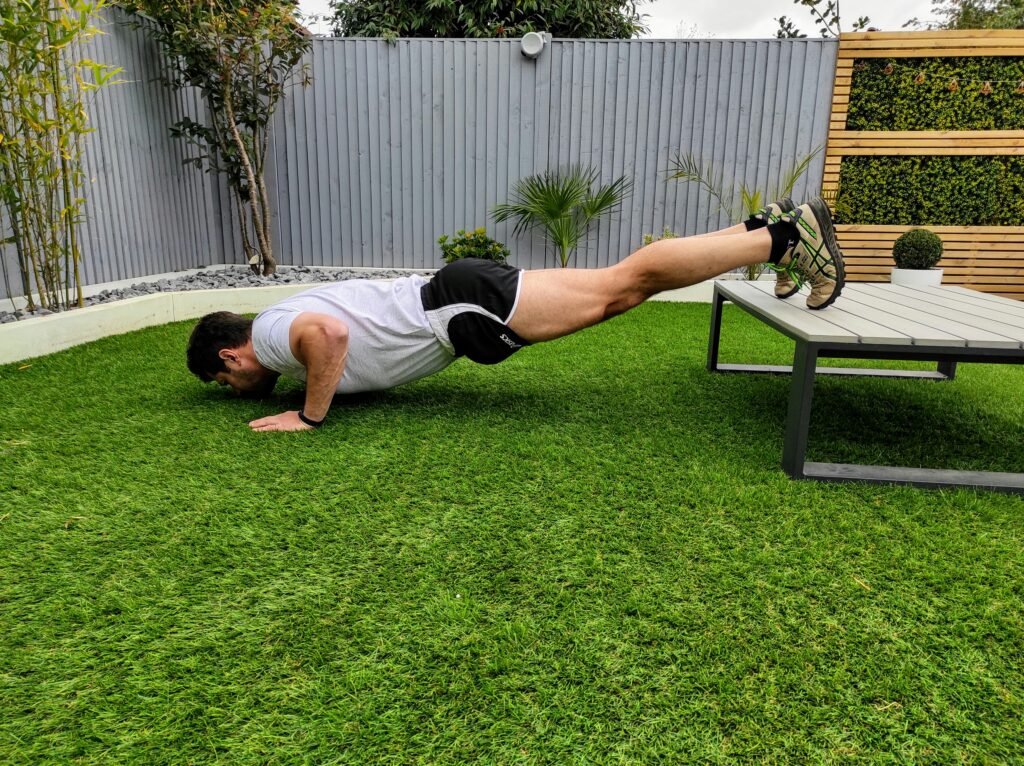
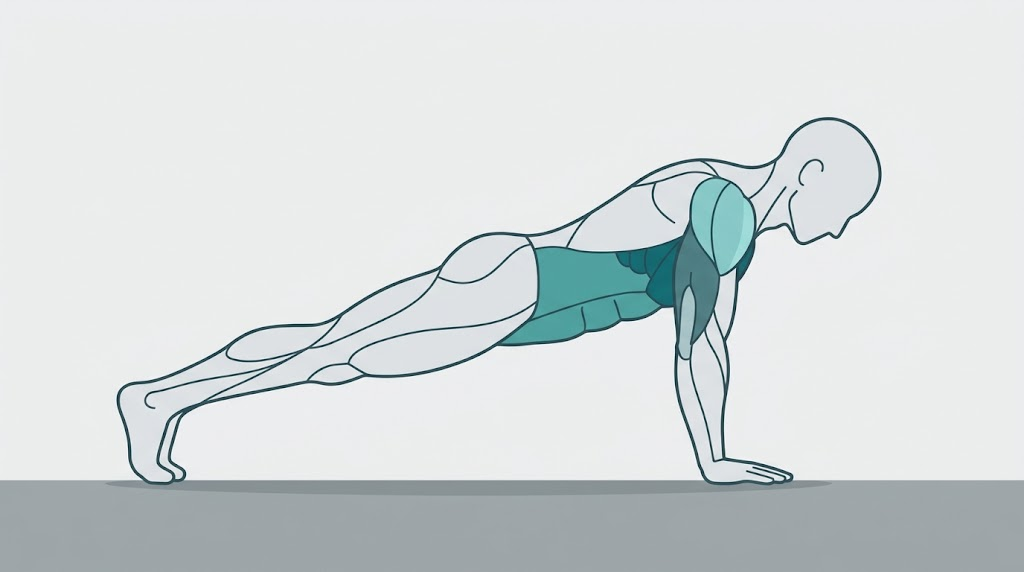
Push ups muscles worked come down to three main players, which are your chest, the fronts of your shoulders and your triceps, while your core and legs hold your body in a straight line.
Table of Contents
Quick Summary
- Main muscles: the pectoralis major (chest), the anterior deltoid (front of the shoulder) and the triceps.
- Supporting muscles: your abs and glutes keep your body in a plank. Some sources also list the serratus anterior, the muscle along your ribs.
- How hard is it? A regular push up moves about 64 percent of your body weight through your hands, according to one force-platform study. A knee push up moves about 49 percent.
- Do variations change the muscles? The research is mixed. Changing the push up mainly changes how heavy it is.
- Make it fit you: use a wall, an incline or your knees until you can do clean reps.
Most guides give a long muscle list and stop. This one adds the load numbers for each version, shows where the evidence is weak and gives you a simple plan for building up.
What Is a Push Up Good For?
The push up is one of the simplest strength exercises there is. It needs no equipment, and you can make it easier or harder by changing the angle of your body.
It trains your upper body and your trunk at the same time, so it is more than a chest exercise. If you are new to bodyweight training, our calisthenics for beginners at home plan shows where it fits in a full week.
Push Ups Muscles Worked: The Full Breakdown
| Muscle | What it does in a push up | How sure are we? |
|---|---|---|
| Pectoralis major (chest) | Pushes your arms forward and together | Listed by every source we read |
| Anterior deltoid (front shoulder) | Helps push you up | Listed by every source we read |
| Triceps (back of the upper arm) | Straightens your elbows | Listed by every source we read |
| Abs and deep core muscles | Keep your hips from sagging | Agreed as stabilizers |
| Glutes and legs | Hold the plank position | Agreed as stabilizers |
| Serratus anterior | Moves your shoulder blades | Listed by some sources, including Hinge Health, but not all |
Some websites add long lists of other muscles, such as the lats, rhomboids and biceps, without a source. Treat the first five rows as the reliable core, and the serratus as a likely helper.
How to Do a Push Up Correctly
- Start in a high plank with your hands about shoulder-width apart and your wrists under your shoulders.
- Keep your body in a straight line from your head to your heels, and tighten your abs and glutes.
- Bend your elbows and lower your chest until your elbows reach about 90 degrees.
- Press back up to the start without letting your hips sag or pike.
Harvard Health’s push up guidance covers easier versions, and the Mayo Clinic’s push up page shows the modified (knee) version. Advice on elbow angle varies between sources, from tucked in to about 45 degrees. A good rule is to keep your elbows angled back and not flared straight out to the sides like a T.
How Much Body Weight Does Each Push Up Lift?
This is the number most guides skip. A 2010 conference paper by Wurm and colleagues, presented at the International Society of Biomechanics in Sports, measured the force through the hands in 23 recreationally fit young adults on a force platform. Each push up version below was significantly different from the others:
| Push up version | Share of body weight through your hands |
|---|---|
| Hands raised on a 60 cm box | 41% |
| Bent-knee push up | 49% |
| Hands raised on a 30 cm box | 55% |
| Regular push up | 64% |
| Feet raised on a 30 cm box | 70% |
| Feet raised on a 60 cm box | 74% |
There are limits. The group was small, young and fit, the tempo was fixed at two seconds per rep, and the study measured force, not muscle activity. It tells you how heavy each version is, not exactly which muscles work harder. It is also a conference paper, not a journal article.
Still, the pattern is useful: raise your hands to make it easier, and raise your feet to make it harder.
Do Different Push Ups Work Different Muscles?
Probably less than the internet suggests.
- Hand width. Sources disagree. A 2015 study by Marcolin and colleagues in the Journal of Athletic Training tested 8 trained people and found narrow hands gave more triceps and chest activation. A 2026 study in Muscles of 20 men found standard and diamond hand positions beat wide hands, with no difference between standard and diamond. Both samples were small, so we would not choose a width for a specific muscle.
- Feet raised (“decline”). Many sites say this hits the upper chest. A 2024 study in 20 active men found no significant difference in chest activity between feet-elevated and floor push ups. The safe claim is that raising your feet makes it harder because more weight goes through your arms.
For a beginner, the practical answer is simple: pick the version you can do with good form, and make it harder gradually.
How to Make Push Ups Easier
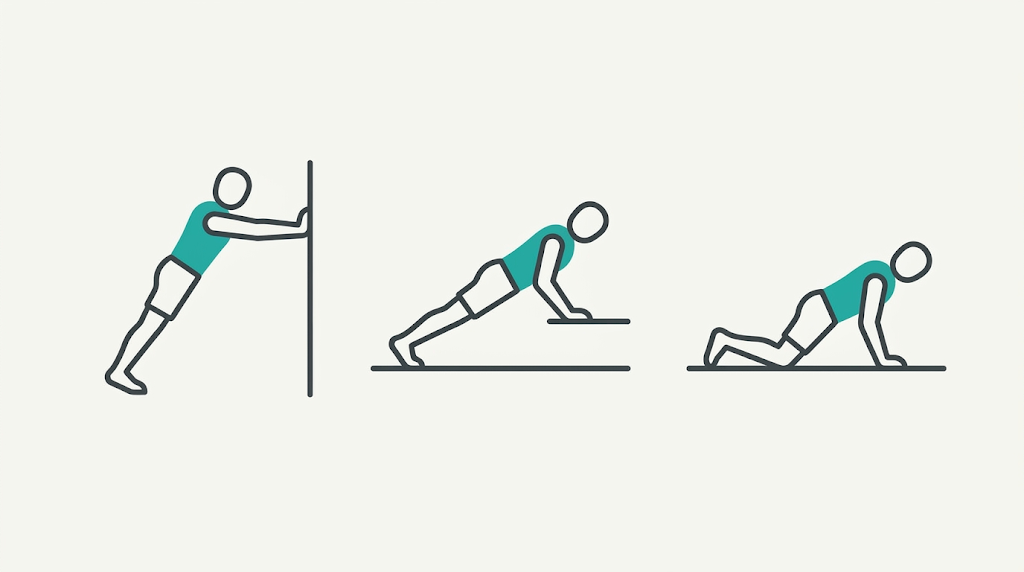
If a full push up is too hard, use one of these, listed from easiest to hardest:
- Wall push up: stand an arm’s length from a wall and press.
- Incline push up: hands on a counter, table or sturdy bench.
- Knee push up: keep a straight line from your knees to your head.
- Slow lowering: from a full plank, lower slowly, then rest your knees and push back up.
NASM’s guidance suggests starting with 3 sets of 8 to 15 reps on the modified push up, and moving to full push ups once you can do 12 to 15 modified reps with good form. That is the clearest “when to progress” rule we found.
Your Beginner Push Up Plan
Now that you know the push ups muscles worked, here is a simple plan. It is our own starting point, not a clinical program.
| Week | Version | Sets | Reps | Rest |
|---|---|---|---|---|
| 1-2 | Wall or incline | 2-3 | 8-12 | 60 seconds |
| 3-4 | Lower incline or knee | 2-3 | 8-12 | 60 seconds |
| 5+ | Full push up when you reach 12-15 clean reps on the knee version | 2-3 | 5-10 | 60-90 seconds |
Healthline’s guidance for beginners is 2 to 3 sets of 5 to 10 reps. The CDC says adults need muscle-strengthening activity on at least 2 days a week, and the Mayo Clinic advises a full rest day between sessions for the same muscles. So do push ups two or three times a week, not every day.
To make your training balanced, add a pulling move such as a row. Our progressive overload at home guide explains how to make a move harder over time.
Wrist and Shoulder Safety
Push ups put weight through your wrists. Healthline’s guide to wrist pain in push ups suggests holding push-up handles or dumbbells so your wrists stay straight, switching to wall or incline versions, or trying a forearm plank. It also says to see a doctor for numbness, tingling, pain at rest or at night, or reduced range of motion.
A few more safety habits:
- Warm up first. Do a few minutes of arm circles and light movement.
- Stop for sharp pain, especially in your shoulder or elbow.
- See a professional if the pain keeps coming back.
- Check with a doctor first if you have a chronic condition or have been inactive for a long time.
What You Need for Push Ups
You can start with nothing. These items make it easier to progress.
- Push up bars: they keep your wrists straighter and let you go a little deeper. Handy if push ups bother your wrists.
- Exercise mat: softens the floor for knee push ups and planks. Check the listing for thickness.
- Resistance band set: bands add resistance once your push ups feel easy, and they are useful for rows too.
- Doorway pull-up bar: pulling balances all the pushing. See our zero to first pull-up progression to get started.
Common Push Up Mistakes
- Sagging hips. Tighten your abs and glutes.
- Flaring your elbows straight out. Angle them back.
- Going halfway. Lower until your elbows reach about 90 degrees.
- Starting too hard. A clean wall push up beats a sloppy floor one.
- Holding your breath. Breathe out as you push.
For more bodyweight moves to pair with them, see our guide to the plank muscles worked.
Quick Answers
What muscles do push ups work? Mainly your chest, front shoulders and triceps, with your core and glutes holding you steady.
Do push ups work your abs? They work your abs as stabilizers, because your core has to keep your body straight, but they are not a direct ab exercise.
Which push up is easiest? The wall push up, followed by the incline and knee versions.
How many push ups should a beginner do? Two to three sets of 5 to 10 reps, two or three times a week, is a sensible starting point.
The Bottom Line
The push ups muscles worked are mainly your chest, front shoulders and triceps, with your core and legs holding the line. You can change how heavy a push up is by changing the angle, but we would not count on small tweaks to target one muscle.
Start with the version you can do cleanly, follow the plan, and move up one step at a time. Give it a month, and you will probably be stronger.
Disclaimer & Affiliate Disclosure
This article is for informational purposes only and should not be taken as medical advice. Always consult with a qualified healthcare provider or certified fitness professional before starting or changing your diet or exercise routine. This article may also contain affiliate links. If you purchase through these links, we may earn a small commission at no extra cost to you.