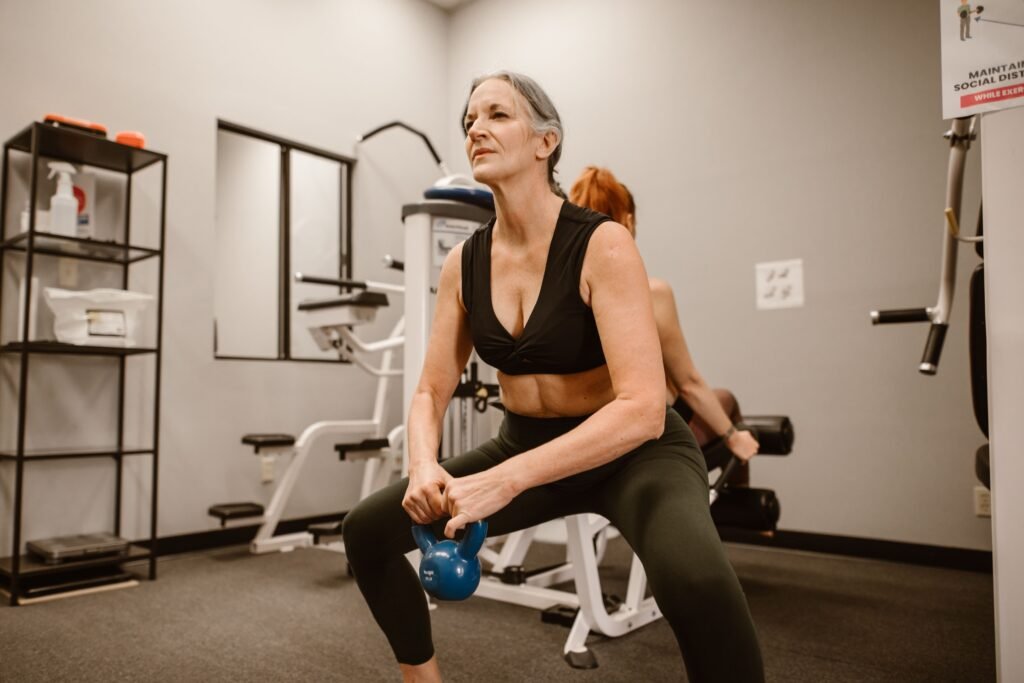
A goblet squat for beginners is a squat where you hold one dumbbell or kettlebell against your chest, and the weight in front of you helps you sit down tall instead of folding forward.
Table of Contents
Quick Summary
- What it is: a squat with one weight held at chest height, using a dumbbell or a kettlebell.
- Muscles: the big muscles of your thighs and hips, with your core bracing to hold the weight in front of you.
- Sets and reps: 2 to 3 sets of 8 to 12 reps, 2 to 3 non-consecutive days a week, based on the ACSM’s guidance for novices.
- Weight: pick one that makes the last reps hard but clean. The chart below gives starting ranges for kettlebells.
- Make it easier: squat down to a chair or box and lightly tap it.
- Safety: stop for sharp pain, and see a professional if knee pain lasts more than about a week.
Most guides list a few form cues and stop. This one adds a weight chart, a step-by-step plan, a chair version for when depth is hard and what the research says.
What Is a Goblet Squat?
A goblet squat is a squat where you hold a single weight close to your chest, the way you would hold a goblet. You can use a dumbbell or a kettlebell. The weight stays in front of your body, which acts like a counterbalance. That makes it easier to keep your chest up and sit between your hips.
It suits beginners because the movement is simple to learn, and you can change the difficulty by changing the weight, the depth or the tempo. If you have not trained legs before, it is a good first loaded squat. Our guide to dumbbell exercises for beginners shows where it fits in a full routine.
Goblet Squat for Beginners: Step-by-Step Form
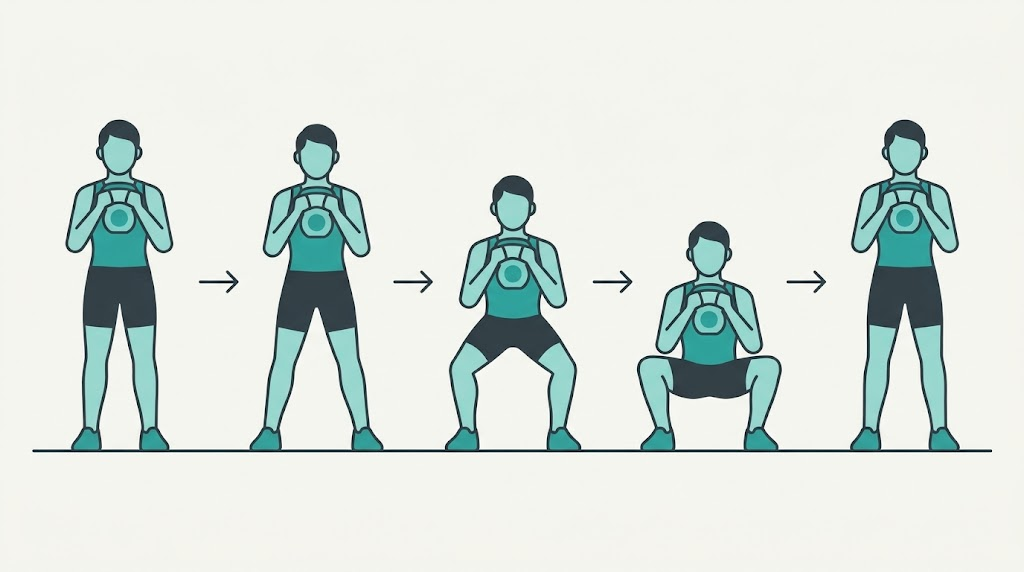
- Hold the weight. Hold a dumbbell upright with both hands cupped under the top end, or hold a kettlebell by its handle (the “horns”). Keep it against your chest with your elbows tucked.
- Set your stance. Stand with your feet hip-width to shoulder-width apart, with your toes pointing forward or turned out slightly.
- Brace. Take a breath in and tighten your abs, as if someone were about to tap your stomach.
- Sit down. Push your hips back and bend your knees. Lower until your thighs are about parallel to the floor, or as low as you can go with your chest up and your heels flat.
- Stand up. Press through your whole foot and stand tall, breathing out as you rise.
A few cues help most beginners. Keep your elbows between or inside your knees at the bottom, because that nudges you to sit between your hips. Keep your knees tracking over your toes and do not let them cave inward. If your heels lift or your lower back rounds, you have gone too low for now.
Which Weight Should You Use? A Kettlebell Weight Chart
The right weight depends on your experience, not just your size. These two retailer guides, Titan Fitness and Bells of Steel, overlap on these starting ranges for kettlebells:
| Your situation | Women | Men |
|---|---|---|
| New to exercise or unsure | 8-12 kg (about 18-26 lb) | 12-16 kg (about 26-35 lb) |
| Some weight training or sport background | 12-16 kg (about 26-35 lb) | about 20 kg (about 44 lb) |
These are loose starting points from equipment retailers, not research, and the two guides do not agree exactly. Age, training history and injuries all change the right weight.
Two rules matter more than the chart. First, if 10 or more goblet squats do not feel challenging, size up. Second, if you are unsure, start lighter and focus on form. Do not buy a heavier weight to “grow into.”
Dumbbell or Kettlebell?
No source we found says one is better for goblet squats. The main difference is the grip. A dumbbell is held upright under the top end, while a kettlebell is held by the handle, and some people find that more comfortable against the chest.
A kettlebell is a good choice if you want a weight that doubles for other moves. Our guide on dumbbells vs kettlebells for home gyms explains the trade-offs. If you plan to keep adding weight, an adjustable dumbbell lets you change the load without buying more.
What the Research Says
A beginner prescription exists. The American College of Sports Medicine’s position stand on resistance training progression (Ratamess and colleagues, 2009) recommends that novices train 2 to 3 whole-body days a week, using 1 to 3 sets of 8 to 12 reps at about 60 to 70 percent of their one-rep maximum. It suggests starting lighter, around 50 to 60 percent, while you learn form, and adding about 2 to 10 percent once you can do one or two extra reps on two sessions in a row. The paper is not about goblet squats specifically, and it is from 2009, but it is a trusted baseline.
The goblet squat is quad-dominant. A 2021 study by Collins and colleagues in the Journal of Strength and Conditioning Research had 16 men and 16 women do goblet squats and landmine squats at 30 percent of body mass. The landmine squat showed lower quadriceps activity and vertical force, so the goblet squat is the more thigh-focused, vertically loaded of the two. It was a small, single-session study at light loads, and it did not compare goblet squats with back or front squats.
Deep squats are not automatically bad for knees. A 2024 scoping review in Frontiers in Sports and Active Living found that, of 15 included studies, only one case study linked deep squats to higher injury risk, while 14 found no harm to knee health. We could only read the abstract, and most of the evidence involved barbell squats in trained people, not beginners. So squat as deep as you can with good form, but do not force depth.
Your Goblet Squat for Beginners Plan
Use this simple plan. It is our own starting point, not a clinical program.
| Week | Days | Sets | Reps | Notes |
|---|---|---|---|---|
| 1-2 | 2 | 2 | 8-10 | Light weight, chair tap if needed |
| 3-4 | 2-3 | 2-3 | 10-12 | Add a 3-second lowering phase |
| 5+ | 2-3 | 3 | 8-12 | Add weight when you can do 1-2 extra reps on two sessions in a row |
Do a short warm-up first: 10 bodyweight squats and 10 glute bridges. Rest 60 to 90 seconds between sets. NASM’s exercise library lists 3 sets of 10 to 15 for the goblet squat, so there is room to do more reps if the weight is light.
How to Make a Goblet Squat Easier
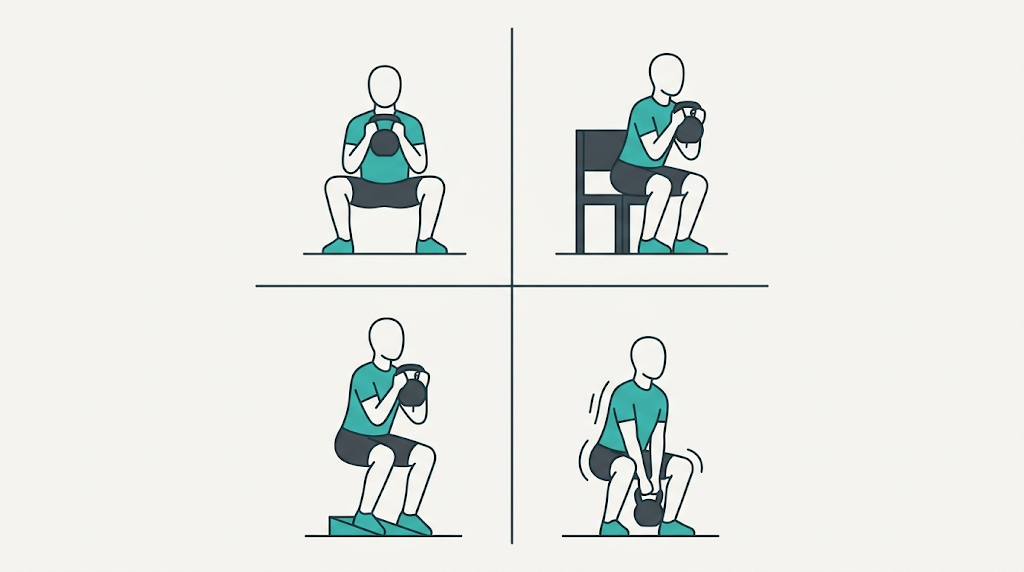
If you cannot reach depth, there are simple fixes.
- Squat to a chair or box. Lower until you lightly touch the seat, then stand. NASM’s guidance for goblet squats suggests this box squat as a regression.
- Use a lighter weight, or no weight at all, until the movement feels smooth.
- Raise your heels slightly on a small wedge if your ankles are tight. A sturdy weight plate or a folded towel under each heel can work.
- Slow down. A smooth, controlled squat is better than a deep, rushed one.
How to Make It Harder
Change one thing at a time. From easiest to hardest:
- Slow the lowering. Take three to five seconds to go down.
- Pause at the bottom for two seconds.
- Add weight in small steps.
- Move on to a split squat or front squat when the goblet squat feels easy. For a bodyweight-and-band way to do it, see our guide to lunges with resistance bands.
Goblet Squat Safety
Pfizer’s health guide says goblet squats are generally easier on the back than traditional back squats, but they can still cause discomfort for people with knee or back problems. Stop if you feel pain, and check with a healthcare provider first if you have a condition.
For knees, the Hospital for Special Surgery advises seeing a physical therapist if knee pain lasts more than about a week, and getting urgent care if you cannot bear weight or your knee gives way. Do not push through sharp pain.
Basic safety habits help too:
- Check the weight is secure in your hands before you squat.
- Use a clear space and flat, supportive shoes.
- Do not hold your breath through the squat.
What You Need for Goblet Squats
You need one weight. Everything else is optional.
- Kettlebell: a simple, comfortable way to hold the weight at your chest. The listing offers several weights, so use the chart above to choose.
- Adjustable dumbbells: one pair covers goblet squats and many other moves, and you can raise the weight as you get stronger. Check the listing for the weight range.
- Hip circle band: a loop band above your knees gives you something to push against, which helps stop your knees from caving in.
- Resistance band set: useful for the rest of your lower-body training. Our leg workout with resistance band guide shows how.
Common Goblet Squat Mistakes
- Leaning forward. Keep your chest up and the weight close to you.
- Letting your knees cave in. Press them out over your toes.
- Lifting your heels. Use a smaller depth or a small heel wedge.
- Rushing the reps. Slow reps work your legs harder.
- Going too heavy too soon. Pick the weight you can control for every rep.
Quick Answers
Is the goblet squat good for beginners? Yes. Holding the weight in front helps most people keep an upright posture, and you can adjust the load easily.
How heavy should I go? Start with the beginner range in the chart above. If 10 or more reps do not feel challenging, go heavier.
Can I use a dumbbell instead of a kettlebell? Yes, hold it upright with both hands under the top end.
How often can I do them? Two to three non-consecutive days a week is a good start.
The Bottom Line
A goblet squat for beginners is simple, safe to scale and easy to do at home. Hold the weight at your chest, sit down tall, keep your knees tracking over your toes and use the chart to pick your starting weight.
Follow the plan above, add weight slowly and give yourself a month before you judge your progress. If your knees complain, shorten the depth or check with a professional.
Disclaimer & Affiliate Disclosure
This article is for informational purposes only and should not be taken as medical advice. Always consult with a qualified healthcare provider or certified fitness professional before starting or changing your diet or exercise routine. This article may also contain affiliate links. If you purchase through these links, we may earn a small commission at no extra cost to you.