Table of Contents
Quick Summary Box
- The split: Monday, Wednesday, Friday — Push & Lower Body, Pull & Posterior Chain, Full-Body & Core
- Session length: 30 to 40 minutes per workout
- Top beginner setup: A Cast Iron Spin-Lock Dumbbell Set gives you a genuinely scalable weight range without needing a full rack
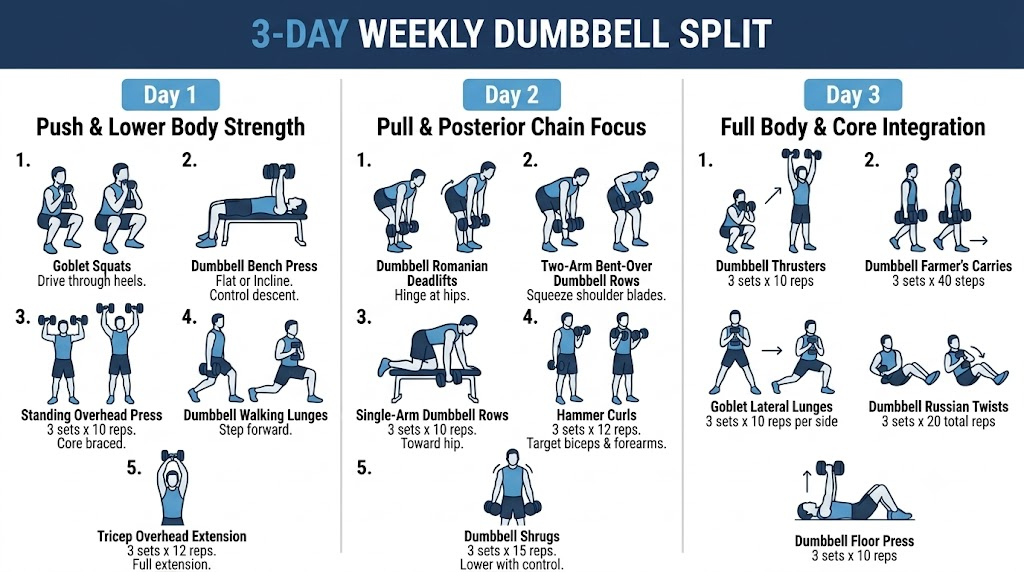
A 3 day dumbbell workout schedule for beginners trains your entire body across three structured sessions per week, each built around a different focus — Day 1 covers pushing movements and lower body strength, Day 2 covers pulling movements and your posterior chain, and Day 3 ties everything together with full-body compound lifts and core work. Each session runs 5 exercises for 3 sets, taking roughly 30 to 40 minutes with rest days between sessions for recovery.
This structure matters for two reasons: progressive strength building requires training the same movement patterns consistently over weeks, and splitting push, pull, and full-body work across three days prevents the muscular imbalances that come from training the same muscles every single session.
Why Dumbbells Are the Ultimate Home Strength Tool
Dumbbells offer something a barbell can’t — genuine independent limb loading. Each side of your body has to lift, stabilize, and control its own weight, which means strength imbalances between your left and right side get exposed and corrected rather than masked by a single bar bridging both hands.
They’re also remarkably joint-friendly. Because your wrists, elbows, and shoulders aren’t locked into a fixed bar path, dumbbells allow a more natural range of motion that often feels more comfortable, especially for beginners still building shoulder stability.
According to Mayo Clinic, strength training two or more times per week, using a resistance heavy enough to fatigue your muscles within 12 to 15 repetitions, improves strength and physical function progressively over time — exactly the principle this 3-day schedule is built around.
Essential Dumbbell Equipment Options for Home Gyms
| Equipment | Weight Range | Space Needed | Beginner Value |
|---|---|---|---|
| Multi-Functional Convertible Set | Adjustable, wide range | Minimal | Excellent — most versatile |
| Cast Iron Spin-Lock Set | Adjustable via plates | Minimal | Excellent — budget-friendly scaling |
| Fixed Rubber Hex Pair | Single fixed weight | Minimal | Good for one specific weight range |
| Adjustable Weight Bench | N/A | Moderate | Optional — expands exercise angles |
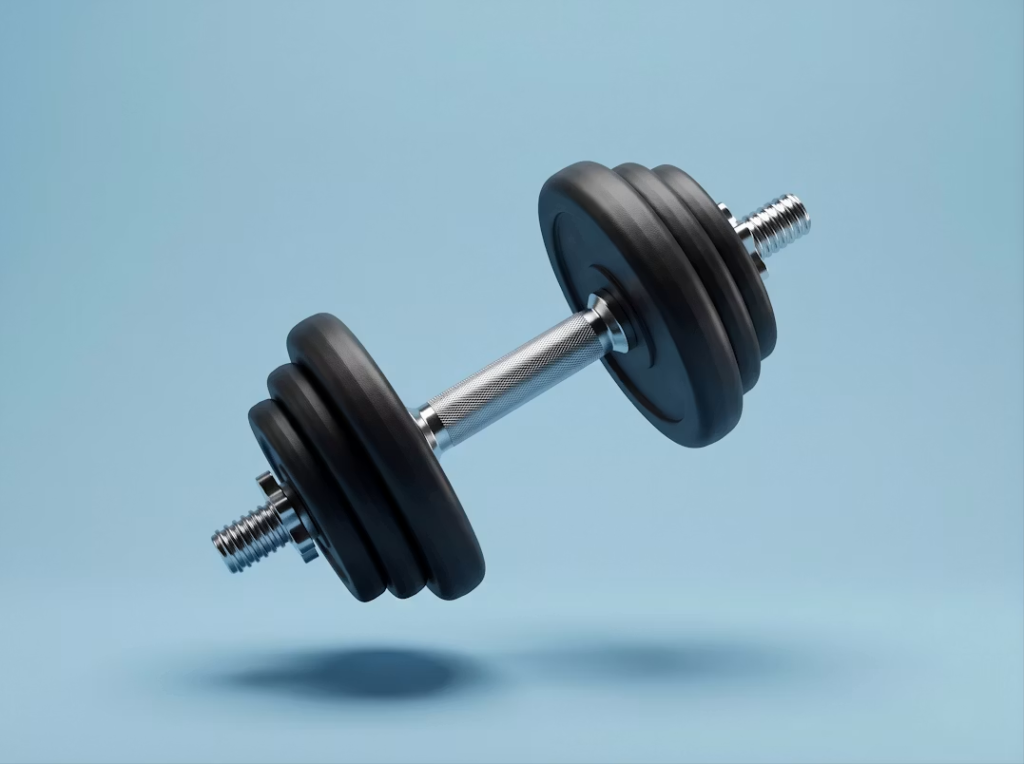
For most beginners, a Cast Iron Spin-Lock Dumbbell Set offers the best combination of affordability and genuine progression, since you can add plates as you get stronger without buying an entirely new set.
If you’d rather skip manually loading plates each session, a Multi-Functional Convertible Dumbbell Set lets you dial in your weight instantly with a quick-adjust mechanism.
If you know exactly what weight range you’ll be working in for the near future, a Rubber Encased Hex Dumbbell Pair is durable, floor-friendly, and won’t roll away between sets.
Once you’re ready to expand your exercise angles beyond floor-based movements, a Foldable Adjustable Weight Bench unlocks incline and decline pressing variations while folding flat for storage.
The 3-Day Beginner Dumbbell Workout Schedule
| Day | Focus | Exercises | Duration |
|---|---|---|---|
| Day 1 | Push & Lower Body | 5 exercises, 3 sets each | 30-40 min |
| Day 2 | Pull & Posterior Chain | 5 exercises, 3 sets each | 30-40 min |
| Day 3 | Full-Body & Core | 5 exercises, 3 sets each | 30-40 min |
Day 1 — Push and Lower Body Strength
- Goblet Squats — 3 sets x 10 to 12 reps. Hold one dumbbell vertically against your chest, squat until thighs are parallel to the floor, drive up through your heels.
- Flat or Incline Dumbbell Bench Press — 3 sets x 8 to 10 reps. Press two dumbbells upward until arms are extended, lower with control until you feel a stretch across your chest.
- Standing Overhead Press — 3 sets x 8 to 10 reps. Press dumbbells from shoulder height to fully overhead, keeping your core braced to avoid arching your lower back.
- Dumbbell Walking Lunges — 3 sets x 10 reps per leg. Step forward into a lunge, drive through your front heel to bring your back leg forward into the next rep.
- Tricep Overhead Extension — 3 sets x 12 reps. Hold one dumbbell overhead with both hands, lower behind your head with control, extend back to full arm extension.
Day 2 — Pull and Posterior Chain Focus
- Dumbbell Romanian Deadlifts — 3 sets x 10 to 12 reps. Hinge at the hips with a slight knee bend, lower dumbbells along your legs until you feel a hamstring stretch.
- Two-Arm Bent-Over Dumbbell Rows — 3 sets x 10 to 12 reps. Hinge forward with a flat back, pull both dumbbells toward your ribs, squeezing your shoulder blades together.
- Single-Arm Dumbbell Rows — 3 sets x 10 reps per side. Support yourself with one hand and knee on a bench, row the dumbbell toward your hip with the opposite arm.
- Hammer Curls — 3 sets x 12 reps. Curl dumbbells with palms facing each other throughout the movement, targeting your biceps and forearms together.
- Dumbbell Shrugs — 3 sets x 15 reps. Hold dumbbells at your sides, shrug your shoulders straight up toward your ears, and lower with control.
Day 3 — Full-Body and Core Integration
- Dumbbell Thrusters — 3 sets x 10 reps. Combine a front squat with an overhead press in one fluid movement, driving the dumbbells overhead as you stand.
- Dumbbell Farmer’s Carries — 3 sets x 40 steps. Hold a heavy dumbbell in each hand and walk with control, keeping your core braced and shoulders level.
- Dumbbell Floor Press — 3 sets x 10 reps. Lying on the floor, press dumbbells upward until arms are extended, lowering until your elbows touch the ground.
- Goblet Lateral Lunges — 3 sets x 10 reps per side. Holding a dumbbell at your chest, step laterally into a lunge, keeping your other leg straight.
- Dumbbell Russian Twists — 3 sets x 20 total reps. Sitting with feet slightly elevated, rotate a dumbbell from side to side while keeping your core engaged throughout.
For a deeper comparison of whether dumbbells or kettlebells suit your specific goals better, our dumbbells vs kettlebells comparison breaks down exactly which tool wins for different training styles.
How to Select Your Starting Weight and Apply Progressive Overload
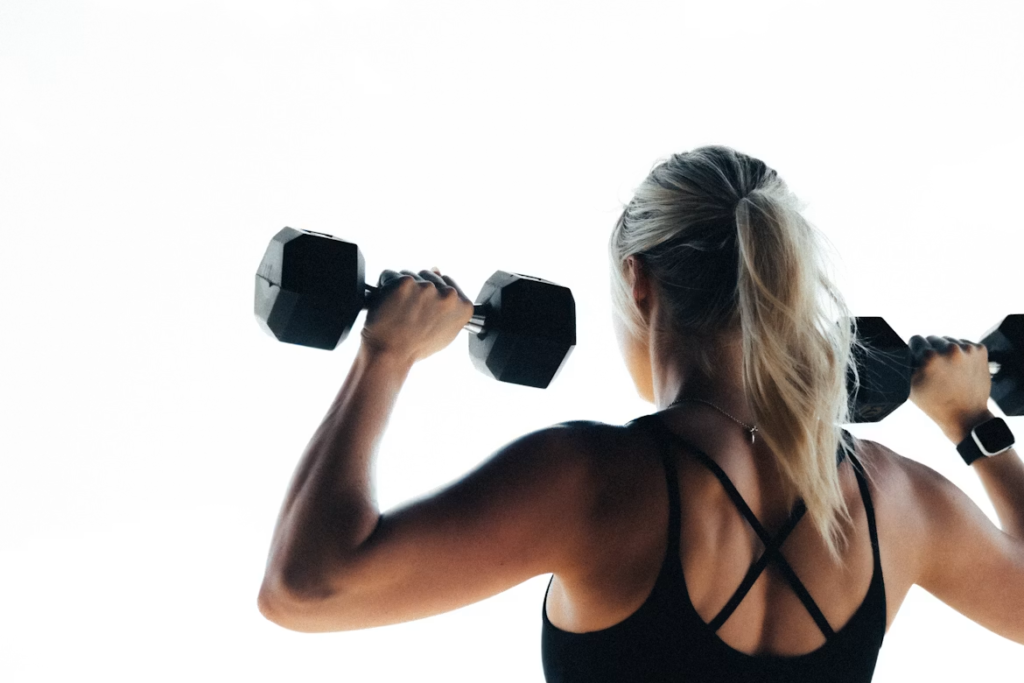
Choosing your first weight is less about a universal number and more about how the last few reps of each set feel. For upper body pushing movements like the bench press and overhead press, most beginners start comfortably in the 8 to 15 pound range per hand. For lower body movements like squats and Romanian deadlifts, starting slightly heavier — often 15 to 25 pounds per hand — is appropriate given the larger muscle groups involved.
The right weight challenges you by the final 2 to 3 reps of each set while your form stays solid throughout. If you’re breezing through all 3 sets with reps to spare, it’s time to increase.
For a complete breakdown of applying progressive overload principles once your current weights start feeling manageable, that guide covers reps, tempo, and rest manipulation as tools that work alongside adding weight, not just as substitutes for it.
Common Beginner Dumbbell Form Mistakes to Avoid
Arching the lower back on overhead presses. Pressing overhead without a braced core often causes the lower back to arch excessively to compensate. Fix: actively brace your core and keep your ribs pulled down throughout the entire press.
Swinging momentum on rows and curls. Using body momentum instead of controlled muscle contraction on rows and curls reduces the actual training stimulus and increases strain on your lower back. Fix: slow down the movement and focus on feeling the target muscle work through the full range.
Using ego weights. Selecting a weight too heavy to control with proper form is one of the fastest routes to injury and slower long-term progress. Fix: choose a weight you can control through the full range of motion for every single rep — strength built with good form compounds far more reliably than strength built with compromised technique.
Frequently Asked Questions
Is 3 days of dumbbell training enough to build muscle?
Yes. Research on resistance training consistently shows that training each major muscle group at least twice a week is sufficient to build strength and muscle over time, and this 3-day split ensures every muscle group gets trained at least twice across the week through the overlapping push, pull, and full-body sessions.
Should beginners use adjustable or fixed dumbbells?
Adjustable dumbbells offer more long-term value since a single set covers a wide weight range as you get stronger, saving both money and storage space compared to buying multiple fixed pairs. Fixed dumbbells can be preferable if you know your target weight range and want the durability and simplicity of a single-piece design.
Can I do this entire routine without an adjustable bench?
Yes, with minor modifications. The floor press replaces the bench press effectively, and most other exercises in this routine are performed standing or on the floor already. A bench simply expands your options for incline and decline variations later on.
How heavy should my first set of dumbbells be?
Most beginners find a starting range of 8 to 15 pounds per hand works well for upper body pushing and pulling movements, while 15 to 25 pounds per hand suits lower body movements better. Choose based on what challenges you by the final few reps of a set while keeping your form solid throughout.
Disclaimer & Affiliate Disclosure
This article is for informational purposes only and should not be taken as medical advice. Always consult with a qualified healthcare provider or certified fitness professional before starting or changing your exercise routine. This article may also contain affiliate links. If you purchase through these links, we may earn a small commission at no extra cost to you.