The biggest myth in home fitness is that building muscle requires a fully stocked gym, a barbell, and plates you keep buying heavier every few weeks. It doesn’t. Progressive overload at home is not only possible — it’s exactly how millions of people have built genuine strength and muscle without ever setting foot in a commercial gym. You don’t need more weight. You need a smarter plan.
This article explains exactly what progressive overload is, gives you five practical ways to apply it using nothing but your bodyweight, and provides a real four-week progression framework you can start today.
Table of Contents
What Is Progressive Overload? (Plain English Version)
Progressive overload is the principle of gradually increasing the demand placed on your muscles over time so they are consistently forced to adapt and grow stronger.
Your body is remarkably efficient at adapting to stress. The first time you do 10 push-ups, it’s genuinely challenging. Do the same 10 push-ups every day for three months without changing anything and your body stops adapting — because it no longer needs to. The stimulus hasn’t changed, so the adaptation stops too.
Progressive overload solves this by ensuring that over time, each session asks slightly more of your muscles than the last. That consistent, incremental increase in demand is what drives continuous strength and muscle gains — with or without a single kilogram of added weight.
According to a peer-reviewed study published in the National Library of Medicine, progressive resistance training produces significant improvements in muscular strength and hypertrophy when the training stimulus is consistently increased over time — confirming that the principle applies regardless of the tools you use to apply it.
The 5 Ways to Progressive Overload at Home Without Adding Weight

1. Increase Repetitions and Sets
The most straightforward method. If you did 3 sets of 10 push-ups last week, do 3 sets of 12 this week. Once you can comfortably complete your target reps with good form, add more.
A simple rule: when you can complete all sets of an exercise with perfect form and feel like you have 3 or more reps left in the tank, it’s time to increase volume. Add 1 to 2 reps per set, or add an additional set before increasing reps further.
Don’t rush this. Small, consistent increases compound powerfully over months.
2. Modify Tempo and Time Under Tension
This is one of the most underused progressive overload tools available to home trainers — and it requires zero extra equipment.
Time under tension (TUT) refers to how long your muscles are working during a set. Slowing down the eccentric (lowering) phase of a movement dramatically increases the difficulty and muscle stimulus without changing a single rep.
Try these tempo variations on a push-up:
- Standard: Lower in 2 seconds, press up in 1 second
- Slow eccentric: Lower in 4 seconds, press up in 1 second
- Isometric pause: Lower in 2 seconds, pause for 2 seconds at the bottom, press up in 1 second
The same 10 reps at a 4-1-1 tempo is significantly harder than 10 reps at a 2-0-1 tempo — and your muscles don’t know the difference between that and added weight. They only know tension and time.
3. Decrease Rest Periods Between Sets
Shortening your rest periods is a simple but effective way to increase training density — doing the same amount of work in less time, which forces your cardiovascular and muscular systems to adapt.
If you currently rest 90 seconds between sets, try 75 seconds next week and 60 seconds the week after. Keep the reps and sets identical and simply reduce recovery time. Your muscles will have to work harder to maintain performance with less recovery, creating a new adaptive stimulus.
Use this method carefully — don’t sacrifice form for speed. If shortening rest causes your technique to break down, you’ve gone too far.
4. Increase Range of Motion and Exercise Velocity
Increasing your range of motion (ROM) means taking a movement through a larger arc than usual, which increases the stretch on the muscle at the bottom of the movement and the total work done per rep.
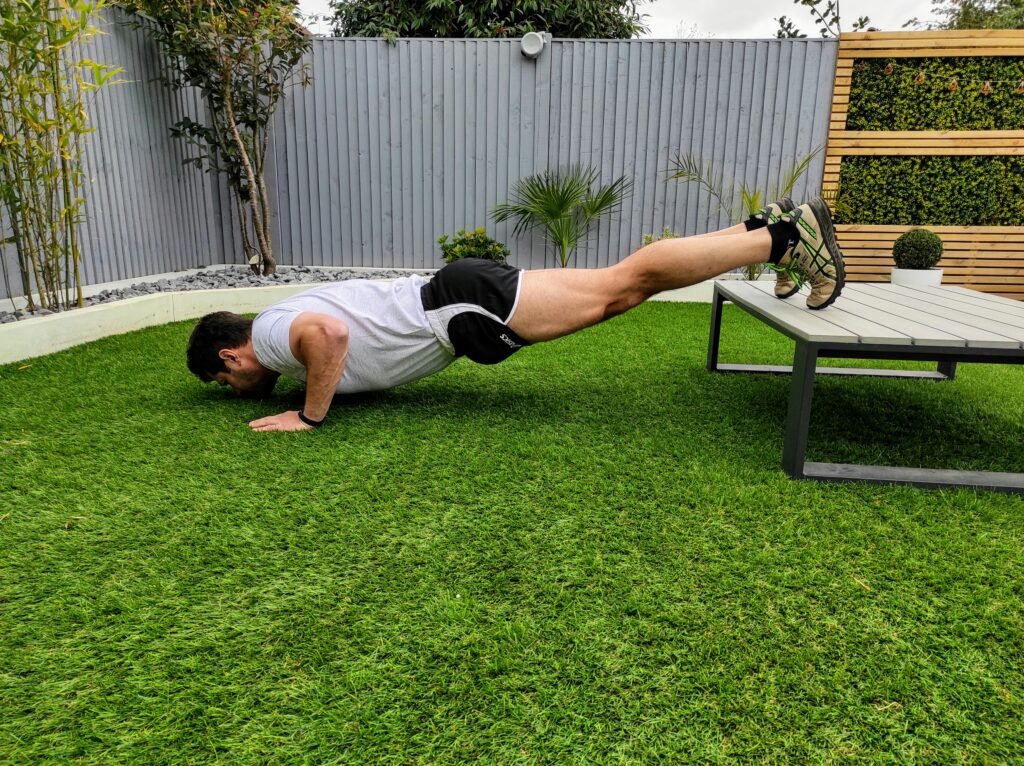
Deficit push-ups are a perfect example. By placing your hands on two books or low risers, you can lower your chest below the level of your hands — deepening the stretch on your pecs and increasing the range through which your muscles work. The same movement, meaningfully harder.
Exercise velocity works in the opposite direction — explosive, fast movements like jump squats or clap push-ups recruit more fast-twitch muscle fibres and create a different type of overload stimulus that standard slow reps don’t access.
5. Progress to Harder Exercise Variations
This is the most intuitive form of progressive overload at home and the one most beginners naturally discover — moving from easier to harder versions of the same fundamental movement.
Here’s what that progression looks like for the three most important bodyweight movement patterns:
Push (Horizontal):
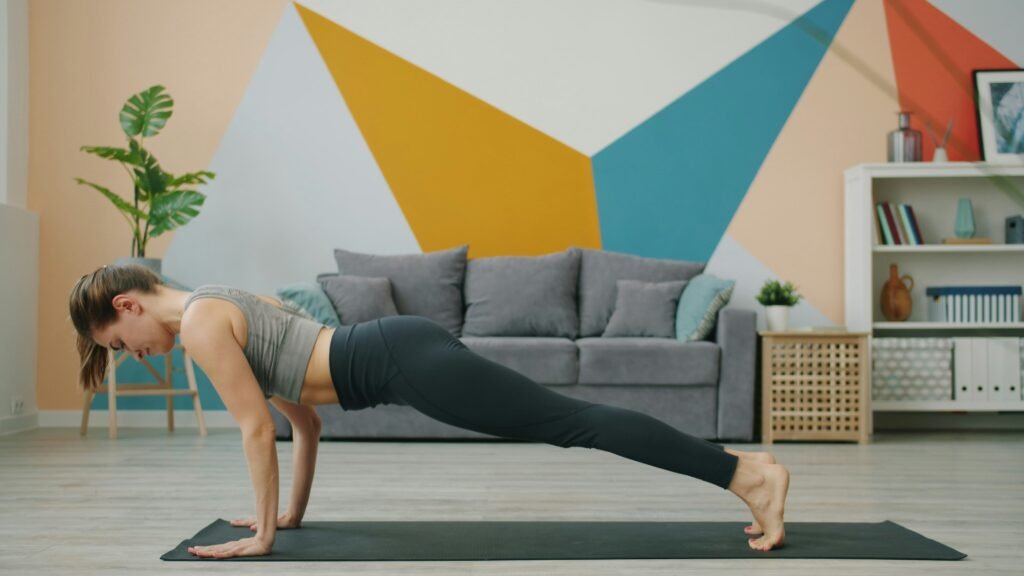
Wall Push-Up → Incline Push-Up → Knee Push-Up → Full Push-Up → Deficit Push-Up → Archer Push-Up → Single-Arm Push-Up
Squat (Lower Body):
Assisted Squat → Bodyweight Squat → Pause Squat → Bulgarian Split Squat → Pistol Squat Progression
Pull (Horizontal):
Doorway Row (high angle) → Doorway Row (low angle) → Inverted Row → Inverted Row with Feet Elevated
To master upper-body pulling progressions at home without gym machines, installing a multi-grip doorway pull-up bar on Amazon gives you an essential station for back and arm development
Each step in these progressions represents a meaningful increase in difficulty — a genuine overload — that requires no added weight whatsoever.
The 4-Week Home Progressive Overload Framework
Here’s a practical, structured four-week progression for the three fundamental movements. Apply these in a beginner home workout routine two to three times per week with rest days in between.
Push-Up Progression
| Week | Variation | Sets x Reps | Tempo |
|---|---|---|---|
| Week 1 | Knee Push-Up | 3 x 10 | 2-0-1 |
| Week 2 | Knee Push-Up | 3 x 12 | 3-0-1 |
| Week 3 | Full Push-Up | 3 x 8 | 2-1-1 |
| Week 4 | Full Push-Up | 3 x 10 | 3-1-1 |
Bodyweight Squat Progression
| Week | Variation | Sets x Reps | Tempo |
|---|---|---|---|
| Week 1 | Assisted Squat | 3 x 12 | 2-0-1 |
| Week 2 | Bodyweight Squat | 3 x 12 | 3-0-1 |
| Week 3 | Pause Squat | 3 x 10 | 2-2-1 |
| Week 4 | Bulgarian Split Squat | 3 x 8 each | 2-1-1 |
Doorway Row Progression
| Week | Variation | Sets x Reps | Tempo |
|---|---|---|---|
| Week 1 | Doorway Row (high angle) | 3 x 10 | 2-0-1 |
| Week 2 | Doorway Row (high angle) | 3 x 12 | 3-0-1 |
| Week 3 | Doorway Row (low angle) | 3 x 10 | 2-1-1 |
| Week 4 | Doorway Row (low angle) | 3 x 12 | 3-1-1 |
How to read the tempo: The three numbers represent seconds for the lowering phase, pause, and lifting phase respectively. 3-1-1 means lower for 3 seconds, pause for 1 second, lift for 1 second.
When Bodyweight Alone Reaches Its Limit
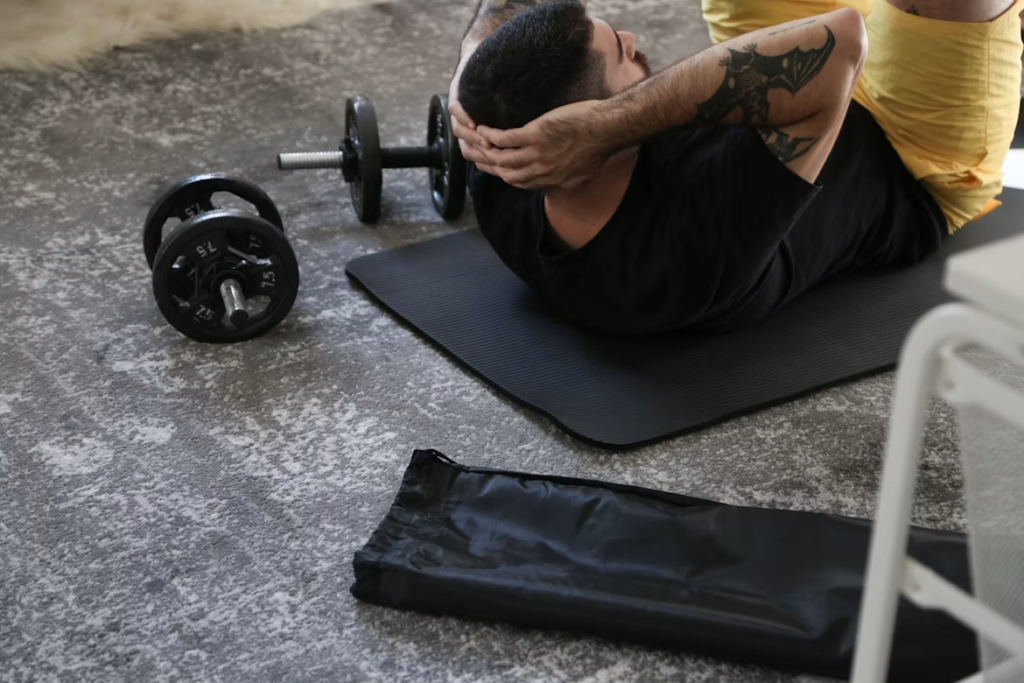
Bodyweight training will take you remarkably far — but there comes a point, usually after several months of consistent progression, where the hardest bodyweight variations become genuinely difficult to progress further without external load.
This is not a failure. It’s a milestone. It means your bodyweight foundation is solid enough to start adding resistance.
When you reach that point, a versatile adjustable dumbbell set is the single most practical investment a home trainer can make. Adjustable dumbbells replace an entire rack of fixed weights in one compact unit — giving you access to a wide range of loads for every movement pattern without dedicating a room to equipment.
Recovery and Nutrition: The Hidden Multipliers
Progressive overload creates the demand for muscle growth. Recovery and nutrition are where the actual growth happens.
Without adequate protein, your body lacks the raw material to repair and rebuild the muscle fibres broken down during training. Aim for 1.6 to 2 grams of protein per kilogram of body weight daily — prioritising whole food sources like chicken, eggs, fish, and legumes wherever possible.
On days when whole food protein sources aren’t practical, a clean whey protein powder taken post-workout is a convenient, effective way to ensure your muscles get what they need within the critical recovery window.
Pair your nutrition with a smart active recovery strategy on off days — gentle walking, foam rolling, and mobility work keep blood flowing to recovering muscles without adding training stress. For a full breakdown of how to structure your training and recovery week as a beginner, our structured home workout plan gives you a complete framework to follow.
The Bottom Line
Progressive overload at home is not a workaround. It is the method. The principle that drives muscle growth and strength adaptation is the same whether you’re using a barbell, a dumbbell, or nothing but your bodyweight and the floor beneath you.
Increase your reps. Slow your tempo. Shorten your rest. Deepen your range. Progress to harder variations. Apply any one of these five tools consistently over weeks and months and your body will have no choice but to adapt.
The gym is optional. The principle is not.
Disclaimer & Affiliate Disclosure:
This article is for informational purposes only and should not be taken as medical advice. Always consult with a qualified healthcare provider or certified fitness professional before starting or changing your exercise routine. This article may also contain affiliate links. If you purchase through these links, we may earn a small commission at no extra cost to you.