Table of Contents
Quick Summary Box
- The sweet spot: 20 to 45 minutes of focused, structured training
- Why longer isn’t automatically better: Diminishing returns from fatigue and declining form kick in past this window
- Track your intervals, not the clock on the wall: A free smartphone interval timer app keeps your work and rest periods honest
How long should a home workout be for weight loss? Somewhere between 20 and 45 minutes of focused, high-intensity or structured resistance training, depending on your session type. Longer sessions often produce diminishing returns — fatigue accumulates, form breaks down, and the extra time rarely adds proportional extra results. Quality and consistency within that window matter far more than chasing a longer clock time.
Why Workout Quality Beats Duration
It’s tempting to assume more time in a session automatically means more results. In practice, a focused 25-minute session with genuine effort throughout usually outperforms a meandering 60-minute session where half the time is spent resting, scrolling, or going through the motions.
Effort density — how much genuine work you pack into the time you have — matters more than raw duration. This is exactly why short, well-structured home workouts can be just as effective as much longer gym sessions, provided the intensity and structure are actually there.
The Sweet Spot: Why 20 to 45 Minutes Works Best for Weight Loss
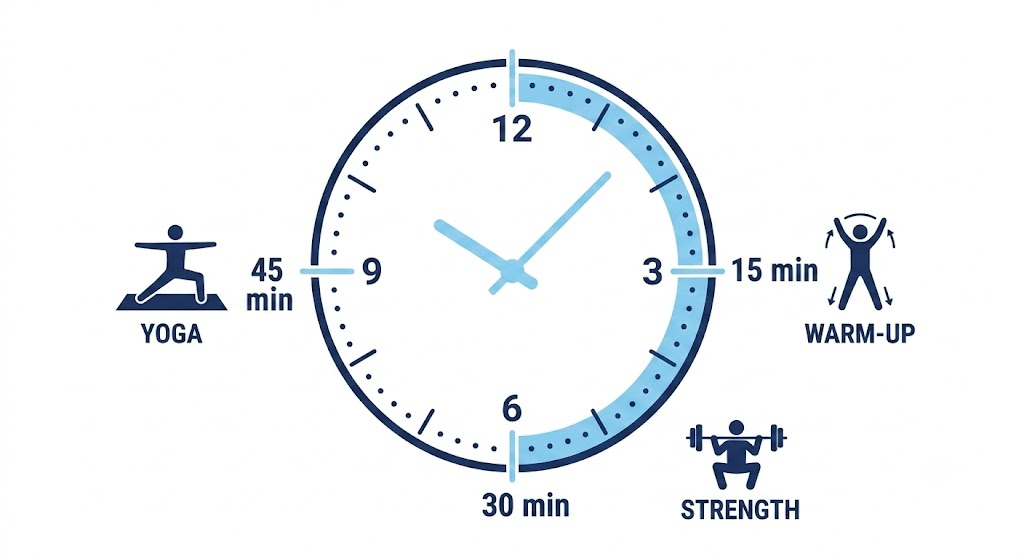
20 to 30 minutes suits high-intensity work — HIIT circuits, fast-paced bodyweight sessions — where the effort level is high enough that sustaining it much longer becomes genuinely counterproductive rather than beneficial.
30 to 45 minutes suits structured resistance training, where you’re moving through multiple exercises with rest periods between sets, giving you enough time to properly work several muscle groups without excessive fatigue setting in.
Beyond 45 minutes, most home workouts start running into diminishing returns — not because exercise stops working, but because focus, intensity, and form all tend to decline as fatigue accumulates, meaning the extra time delivers less value than the time already spent.
Intensity vs. Duration: EPOC (Afterburn Effect) Explained Simply

You may have heard that intense exercise keeps burning calories after you’ve finished. This is real and is called EPOC — Excess Post-Exercise Oxygen Consumption, commonly nicknamed the “afterburn effect.”
Here’s the honest version: after a genuinely intense session, your body does burn a modest amount of extra calories for a period afterward as it returns to its resting state. This effect is real, but it’s meaningfully smaller than the dramatic “burn calories all day!” claims sometimes made in fitness marketing — think of it as a helpful bonus on top of your session’s direct calorie burn, not a separate major calorie-burning event on its own.
The practical takeaway: prioritizing genuine intensity within your 20 to 45 minute window matters more than chasing EPOC directly, since intensity is what drives both your in-session calorie burn and whatever modest afterburn effect follows.
Maximizing Calorie Burn in Short Windows
Getting genuine results from a shorter session comes down to a few practical tools and habits.
A Tangle-Free Adjustable Jump Rope delivers rapid cardiovascular conditioning in a tiny footprint — a few minutes of jump rope intervals genuinely rivals much longer steady-state cardio for calorie burn per minute.
Staying focused during an intense session matters too. A CYPERROCK Moisture-Wicking Headband keeps sweat out of your eyes so you’re not breaking focus or slowing down mid-set to wipe your face.
For keeping your work and rest intervals honest, a free smartphone interval timer app — Tabata Timer, Seconds, or your phone’s built-in stopwatch with interval features — does the job just as well as a physical gym clock, without the extra purchase or wall space.
Sample Workout Plans by Time Constraints

| Duration | Format | Example Structure |
|---|---|---|
| 15 minutes | Express HIIT | 4 exercises, 40s work / 20s rest, 4 rounds |
| 30 minutes | Balanced Strength & Cardio | 5 strength exercises + 5 min cardio finisher |
| 45 minutes | Complete Circuit | 6-8 exercises, 3 sets each, full rest periods |
The 15-minute version works best when your schedule is genuinely tight — it’s not a lesser workout, just a more compressed one, and pairs well with our home HIIT workouts guide for a ready-made routine. The 45-minute version gives you room for a proper structured session using something like our 3-day resistance band workout schedule when time genuinely allows.
3 Signs Your Home Workouts Are Too Long
Persistent, excessive soreness that doesn’t improve. Some soreness after training is normal, but sessions that consistently leave you unable to function normally the next day may be running longer or harder than your body can currently recover from.
Declining motivation and dread before sessions. If workouts that used to feel manageable now feel like a chore you’re avoiding, session length — not just intensity — may be contributing to genuine burnout.
Diminishing performance within the session itself. If your last 15 minutes consistently look and feel noticeably worse than your first 15 — sloppier form, slower pace, reduced effort — that’s a sign your effective working window may be shorter than your actual session length.
Frequently Asked Questions
Is a 20-minute home workout enough to lose weight?
Yes, provided the intensity and structure are genuinely there. A focused 20-minute HIIT session can produce meaningful calorie burn and cardiovascular benefit — weight loss ultimately depends on your overall calorie balance across the full day and week, not any single session’s length.
Should I work out every day for weight loss?
Not necessarily every day at high intensity. The CDC’s physical activity guidelines recommend 150 minutes of moderate activity or 75 minutes of vigorous activity per week, plus muscle-strengthening activity twice weekly — which can be achieved through several structured sessions rather than daily training, with rest days built in for recovery.
Does workout timing matter for calorie burn?
The time of day you train matters far less than total training consistency and intensity across the week. What matters more for weight loss specifically is genuinely completing your planned sessions consistently, whichever time of day that happens to be.
What is better for fat loss: fast cardio or weight lifting?
Both contribute meaningfully, and combining them tends to outperform either alone. According to Mayo Clinic Health System, fitness trackers commonly overestimate calorie burn significantly — a 45-minute session showing 1,200 calories burned may actually be closer to 400 to 700 — which is a good reminder that overall calorie balance across your diet matters more than exercise alone, regardless of whether that exercise is cardio or resistance training.
Disclaimer & Affiliate Disclosure: This article is for informational purposes only and should not be taken as medical advice. Always consult with a qualified healthcare provider or certified fitness professional before starting or changing your exercise routine. This article may also contain affiliate links. If you purchase through these links, we may earn a small commission at no extra cost to you.