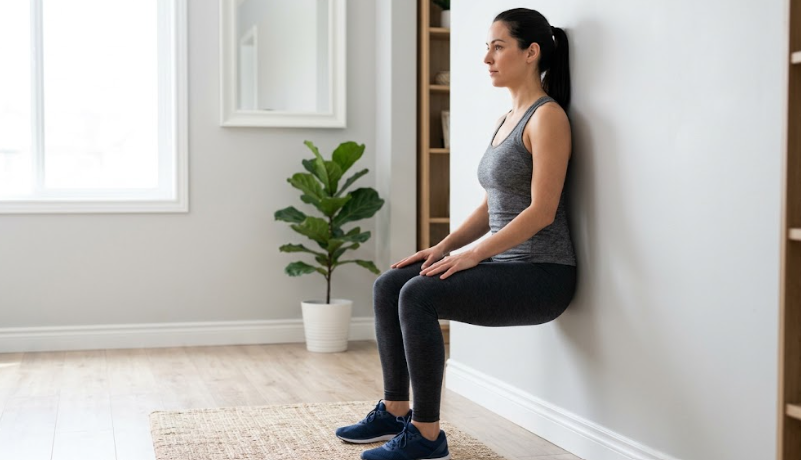
A wall sit for beginners is a simple leg exercise where you lean your back against a wall and hold a seated position, with no equipment and almost no setup.
Table of Contents
Quick Summary
- What it works: your quads, glutes and core, according to Mayo Clinic Health System, plus your calves and hamstrings in a supporting role.
- Form: back flat on the wall, feet about two feet out, knees bent to 90 degrees and stacked over your ankles.
- How long to hold: start with 20 to 30 seconds. Sources vary, from 5 seconds up to a minute for beginners.
- Make it easier: slide up into a shallower, “quarter” wall sit.
- Safety: breathe the whole time, and stop if your knees hurt in a sharp way.
Most guides give you a hold time and stop there. This one adds a 4-week plan, a safer way to start and what the research does and does not say about isometric exercise.
What Is a Wall Sit?
A wall sit is an isometric exercise, which means your muscles hold a position instead of moving. You slide down a wall until your knees are bent and hold there, as if you were sitting on an invisible chair.
It suits beginners because it is easy to scale. You can sit shallow to make it easier or deeper to make it harder, and you can do it in a hallway, with no gear.
Wall Sit Muscles Worked
The Mayo Clinic Health System says a wall sit targets your glutes, quads and core. Other fitness sources add your calves and hamstrings as helpers.
Because you are holding still, the burn builds up fast in the front of your thighs. That is normal.
How to Do a Wall Sit Correctly
- Stand with your back flat against a wall and your feet about two feet in front of you, shoulder-width apart.
- Slide down until your knees are bent to about 90 degrees.
- Check that your knees are stacked over your ankles, not far past your toes.
- Keep your upper back against the wall and tighten your abs.
- Hold, breathing slowly in and out.
- Press through your heels to slide back up.
Mayo Clinic’s guidance also says that holding your breath during isometric exercise is a misconception to avoid, and that you should breathe slowly in and out. That matters, because breath-holding is a common beginner mistake.
Start Shallow: The Quarter Wall Sit
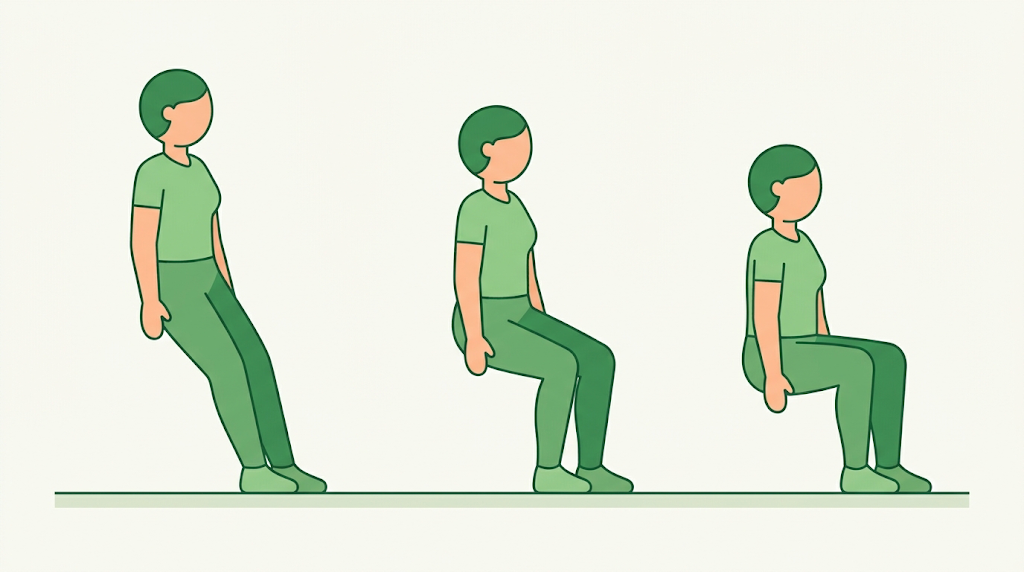
If the full 90-degree position is too hard, do not force it. NASM and Hevy both suggest a shallower start, such as hips above knees, often called a quarter wall sit. Cleveland Clinic suggests a beginner depth of about 45 degrees.
Start where you can hold for 15 to 20 seconds with good form. Then lower yourself a little deeper each week.
How Long Should Beginners Hold a Wall Sit?
Advice varies, and that is worth knowing:
- NASM: 20 to 30 seconds, 2 to 3 times a week, adding 5 to 10 seconds a week up to about a minute.
- Hevy: 2 to 3 rounds of 20 to 30 seconds.
- Cleveland Clinic: from 5 seconds up to a minute.
- Mayo Clinic Health System: start with 20 seconds and build up to 2 minutes, for four sets, three times a week. This protocol is aimed at lowering blood pressure.
For a first month, 20 to 30 seconds is a sensible starting point, because it is within every range above.
Your 4-Week Wall Sit for Beginners Plan
Do this three times a week with a rest day between sessions. Rest 45 to 60 seconds between holds. This is our own beginner starting point, not a clinical program.
| Week | Holds | Hold time | Depth |
|---|---|---|---|
| 1 | 3 | 20 seconds | Shallow (quarter) |
| 2 | 3 | 30 seconds | Shallow to halfway |
| 3 | 3 | 40 seconds | Halfway to 90 degrees |
| 4 | 3 | 45 to 60 seconds | 90 degrees if comfortable |
If a week feels too hard, repeat the previous week. Progress means holding good form, not a bigger number on a timer.
What the Research Says About Isometric Exercise
A 2019 systematic review by Oranchuk and colleagues in the Scandinavian Journal of Medicine & Science in Sports looked at isometric training lasting at least three weeks, covering 26 research outputs. The authors reported substantial improvements in muscle growth and maximal force across a range of intensities. They also found that training at longer muscle lengths produced more muscle growth than the same work at shorter lengths.
There are limits. The review was not about wall sits specifically, only a few studies met the criteria, and tendon adaptations were seen only at high effort (70 percent of maximum or more). So a wall sit is a reasonable way to build leg strength, but it is not a complete program.
Wall Sits and Blood Pressure
You may have read that wall sits lower blood pressure. A 2023 meta-analysis in the British Journal of Sports Medicine of 270 randomized trials (15,827 participants) reported that isometric exercise led to the largest blood-pressure reductions of the training types studied. In coverage by MDedge, the wall squat ranked highest for lowering systolic pressure.
The same coverage lists caveats: the quality of the trials varied, there was no blinding and there was publication bias. So this is promising, not proven for you.
If you have high blood pressure or a heart condition, talk to your doctor before starting isometric exercise, and never hold your breath.
Knee Safety
A wall sit loads your knees. The American Academy of Orthopaedic Surgeons’ guide to patellofemoral pain lists squatting among the activities that can repeatedly stress the knee. It advises stopping painful activity until the pain settles, building up gradually and strengthening your quads and hips.
For a wall sit, that means:
- Stay in a shallower position if your knees ache.
- Keep your knees over your ankles, not collapsing inward.
- Stop if you feel sharp pain, and see a healthcare professional if it keeps coming back.
Wall Sit Variations
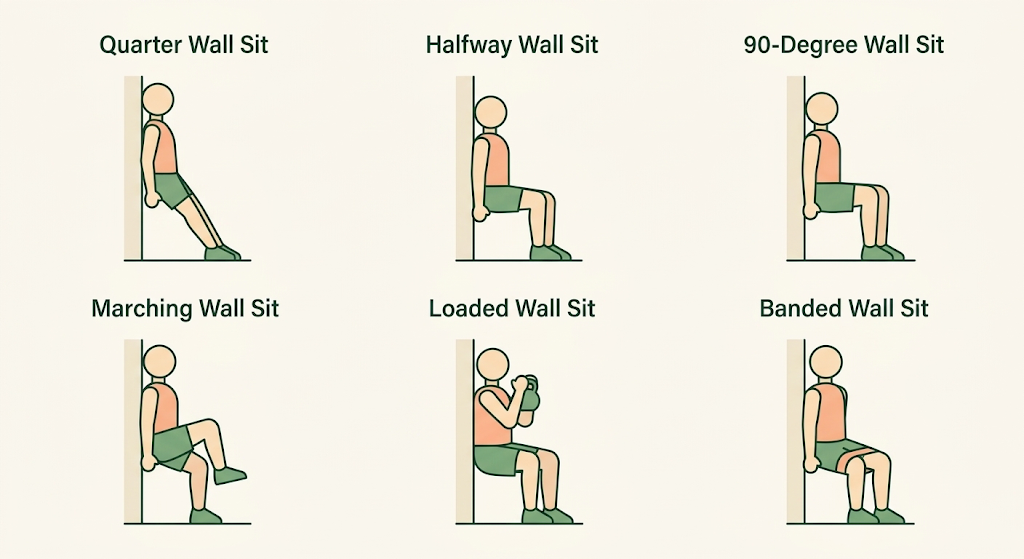
Once the basic version feels easy, try one of these:
- Marching wall sit: lift one foot a few inches, then switch.
- Loaded wall sit: rest a weight on your thighs.
- Single-leg wall sit: extend one leg, for advanced trainees only.
- Wall sit with a band above the knees: press your knees out against a loop band. This is our suggestion, not a researched variation.
Hevy lists the quarter, loaded and single-leg versions, and NASM lists stability-ball and marching versions.
Warm-Up and Cool-Down
Spend two to three minutes warming up before your holds. Try 10 bodyweight squats, 10 glute bridges and a few easy knee bends against the wall.
After your last hold, stand up slowly, walk around for a minute and shake out your legs. If your thighs feel tight, a gentle quad stretch is enough. Your legs will probably wobble for a moment, which is normal.
How Wall Sits Fit Into a Leg Day
A wall sit works best as one part of a leg session, not the whole thing. Here is a simple example. It is our own suggestion, not a clinical program.
| Order | Exercise | Sets and reps |
|---|---|---|
| 1 | Wall sit | 3 holds of 20-40 seconds |
| 2 | Glute bridge | 2 sets of 12-15 |
| 3 | Split squat | 2 sets of 8-10 per leg |
| 4 | Calf raise | 2 sets of 12-15 |
Do this twice a week on non-consecutive days. On the other days, rest or do light activity like walking.
What You Need for Wall Sits
You need a wall and a floor that does not slip. These items can help you progress.
- Hip circle band: a loop band for the banded variation. Check the listing for the resistance levels.
- Resistance band set: useful for the rest of your leg training too.
- Adjustable dumbbells: for a loaded wall sit once your holds feel easy.
For a bigger leg routine, try our leg workout with resistance band, and see our strength training for beginners guide for how to fit it in.
Common Wall Sit Mistakes
- Holding your breath. Breathe slowly through the hold.
- Sliding too deep too soon. Start shallow and work down.
- Feet too close to the wall. That pushes your knees past your toes.
- Resting your hands on your thighs. That takes the load off your legs.
- Chasing a long time with bad form. A clean 30 seconds beats a shaky minute.
Quick Answers
Is a wall sit for beginners safe? Yes for most healthy people, when you start shallow, breathe and avoid sharp knee pain.
How long should a beginner hold a wall sit? About 20 to 30 seconds to start, and build up gradually.
Does a wall sit build muscle? It can build leg strength and some muscle, according to the isometric training review above, but it works best alongside other leg exercises.
How often can I do wall sits? Two to three times a week is enough for most beginners.
The Bottom Line
A wall sit for beginners is a low-risk, high-return leg exercise. Start shallow, keep your knees over your ankles, breathe through every hold and follow the 4-week plan.
Add other leg moves, and give it a month before you judge your progress. If your knees complain or you have a heart condition, check with a professional first.
Disclaimer & Affiliate Disclosure
This article is for informational purposes only and should not be taken as medical advice. Always consult with a qualified healthcare provider or certified fitness professional before starting or changing your diet or exercise routine. This article may also contain affiliate links. If you purchase through these links, we may earn a small commission at no extra cost to you.