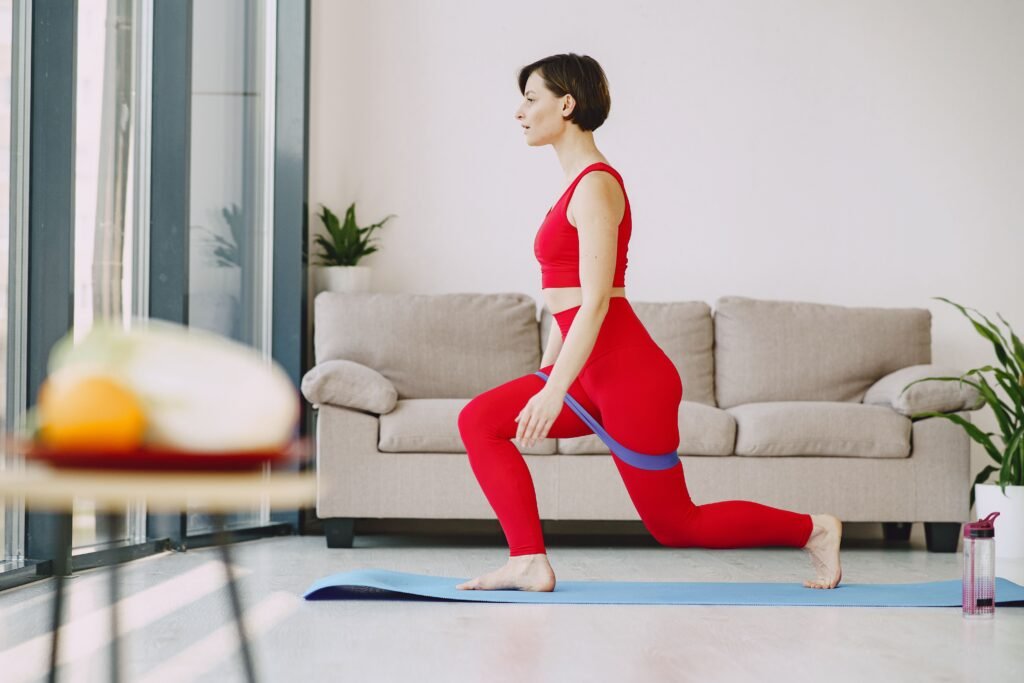
Lunges with resistance bands make a bodyweight lunge harder by adding tension that pulls on your legs, so your glutes and quads work more through every step.
Table of Contents
Quick Summary
- What you need: a resistance band, either a loop around your thighs or a band you stand on.
- Best starting version: a reverse lunge with a loop band just above your knees, 2 sets of 8 to 12 reps per leg.
- How often: 2 to 3 sessions a week. ACSM guidance for beginners is 8 to 12 reps per set.
- Where the band goes: above the knees to cue your knees outward, or at the ankles for more side-glute work.
- Safety: inspect the band before every set, keep your front knee stacked over your ankle and stop for sharp knee pain.
Most guides list four lunge variations and stop. This one explains where to put the band, how to progress and what the research says about the glutes.
Why Add a Band to Lunges?
A bodyweight lunge is a good exercise, but it gets easy quickly. A band adds resistance without needing weights, so you can make the move harder gradually.
A loop band above your knees also gives your hips something to push against. That helps you keep your knee tracking in line with your toes instead of caving inward.
If you are new to bands, our resistance bands for beginners guide explains the types and strengths.
What the Research Says About Your Glutes
A 2015 systematic review by Macadam and colleagues in the International Journal of Sports Physical Therapy measured glute muscle activity across hip exercises. Here are the figures that matter for lunges, as a percentage of maximum voluntary contraction:
- Lateral lunge: gluteus maximus about 26.5% and gluteus medius about 26%, a moderate level.
- Transverse lunge: gluteus maximus about 53.5% and gluteus medius about 58%, a high level.
- Standing band hip abduction (band at the ankle): gluteus medius about 52.9%, a high level.
- Band monster walk: gluteus maximus only about 4 to 6%, with gluteus medius about 19 to 27%. Placing the band lower (near the ankles) activated these muscles more than placing it above the knees.
The review did not test banded lunges directly, and the methods differed between studies, so the numbers are not perfectly comparable. What they suggest is useful: adding a sideways or turning component to a lunge works the side glutes harder, and a band placed lower on the leg raises glute activity in band walks.
That is why the variations below mix forward, reverse and sideways steps.
How to Do Lunges With Resistance Bands
Reverse Lunge With a Loop Band
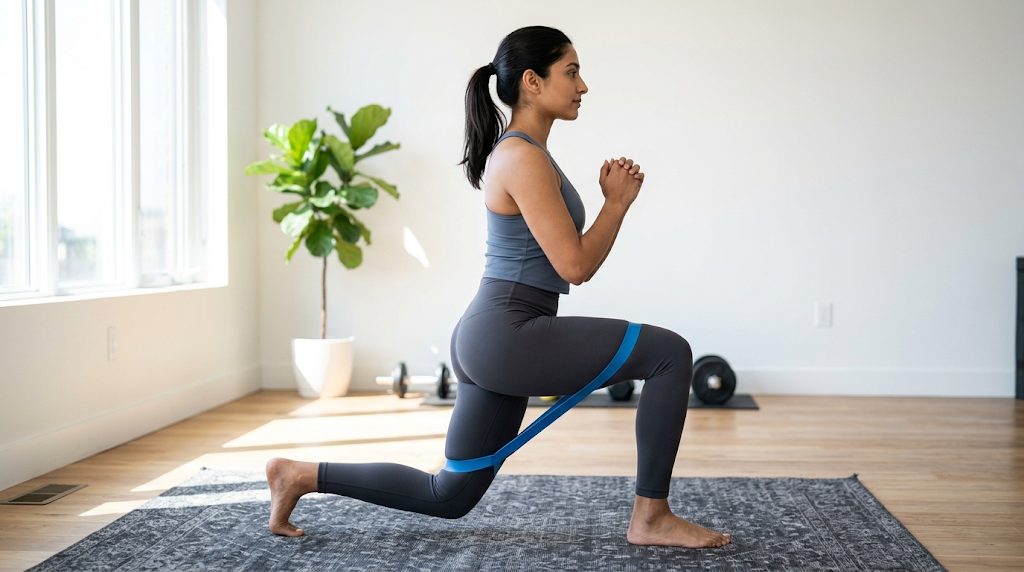
Place a loop band just above your knees and stand tall. Step one foot back, lower until both knees bend, then push through your front heel to stand.
Press your knees gently out against the band the whole time. This is the best starting version because stepping back is easier on most knees than stepping forward.
Lunge Standing on the Band
Stand on the middle of a long band with your front foot and hold the ends at your shoulders or by your sides. Step back into a lunge while the band stays under your front foot.
This version adds resistance as you stand up. If the band goes slack at the bottom, hold your hands lower to keep tension.
Lateral Lunge With a Loop Band
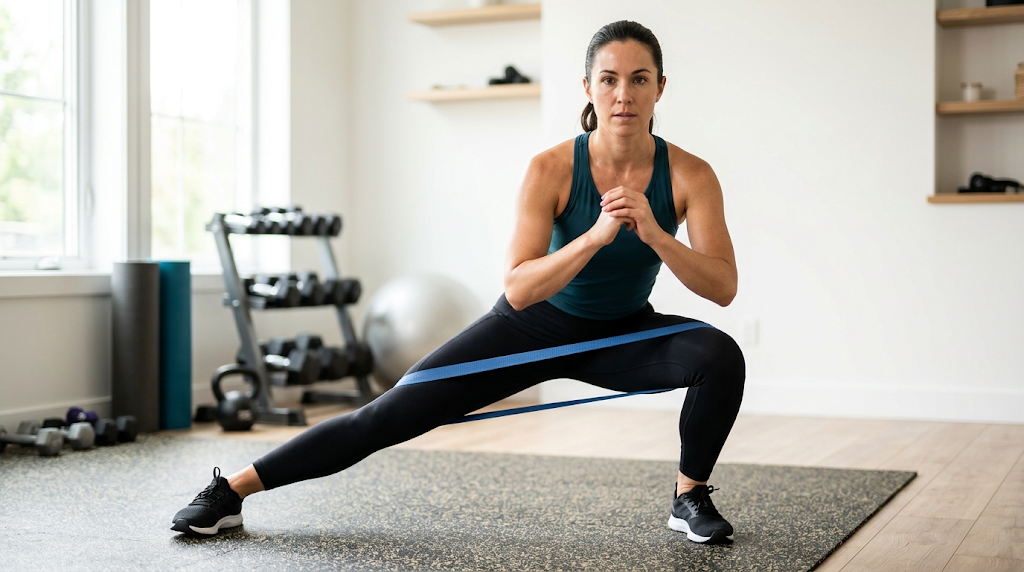
Place a loop band above your knees. Step one foot out to the side and sit back into that hip, keeping the other leg straight. Push off the bent leg to return.
This one trains your side glutes. Keep your toes pointing forward and your chest up.
Walking Lunge With a Loop Band
Place a loop band above your knees and step forward into a lunge, then step through into the next one. Keep a steady, controlled pace and keep tension on the band.
Do this one after you are comfortable with reverse lunges, because walking lunges demand more balance.
Lunge Form and Knee Safety
Good form protects your knees. The National Strength and Conditioning Association’s article The Undervalued Lunge gives these basics:
- Front knee stacked over the ankle. Avoid letting it drift well past your toes.
- Take a long enough step. The stance should be longer than a normal walking stride, because a very short step stresses the patellar tendon at the front of the knee.
- Do not let the front knee turn inward. An inward-turning knee or foot can increase twisting stress on the joint.
A loop band above the knees helps with that last point because it gives you something to push against.
If a lunge hurts your knee in a sharp way, stop and shorten your step or reduce the depth. If knee pain keeps coming back, see a healthcare professional.
Warm Up First
A short warm-up gets your hips and knees ready, so your first set is not your first movement of the day. Spend about three minutes on:
- 10 bodyweight squats
- 10 glute bridges
- 10 leg swings per leg, holding a wall for balance
- 5 slow bodyweight reverse lunges per leg
If your knees feel stiff, add a minute of gentle marching in place.
How Many Reps and Sets?
Start with 2 sets of 8 to 12 reps per leg, resting 45 to 60 seconds between sets. The American College of Sports Medicine’s position stand on resistance training progression recommends 8 to 12 reps per set and 2 to 3 sessions a week for novices.
Our own beginner plan:
| Weeks | Sessions | Sets | Reps per leg |
|---|---|---|---|
| 1-2 | 2 per week | 2 | 8-10 |
| 3-4 | 2-3 per week | 2-3 | 10-12 |
| 5+ | 2-3 per week | 3 | 12 or more, then a stronger band |
This is a starting framework, not a clinical program. If your knees or hips feel off, repeat a week before moving up.
How to Make Lunges Harder
Change one thing at a time. From easiest to hardest:
- Slow the lowering phase. Take three seconds to go down.
- Pause at the bottom. Hold for two seconds.
- Use a stronger band. Move up one resistance level.
- Add dumbbells. Hold a pair at your sides.
What You Need for Banded Lunges
You need one or two bands, and everything else is optional.
- Hip circle band: a fabric loop that stays above your knees without rolling. Check the listing for the resistance levels it includes.
- Resistance band set: several strengths in one purchase, including bands you can stand on.
- Adjustable dumbbells: the simplest way to keep progressing once your bands feel light.
For more lower-body ideas, see our leg workout with resistance band.
Resistance Band Safety
A stretched band stores energy, so treat it like gym equipment. TheraBand’s care and safety guide says to:
- Inspect the band before and after every use. Discard any band that is torn, punctured or nicked.
- Secure any anchor. If you attach a band to something, it must be firmly anchored, and any band can slip or break during use.
- Check for latex. Many bands contain natural rubber latex, which can cause allergic reactions. Non-latex options exist, so check the listing.
- Store it away from sunlight. Keep it in a cool, dry place.
If you have a latex allergy, choose a non-latex band and check with a healthcare professional if you are unsure.
A Simple Banded Leg Day
Here is how banded lunges fit into a full session. This is our own starting plan, not a clinical program. Do each move for 2 sets, resting 45 to 60 seconds between sets.
| Order | Move | Reps |
|---|---|---|
| 1 | Reverse lunge with loop band | 8-12 per leg |
| 2 | Lateral lunge with loop band | 8-10 per leg |
| 3 | Banded glute bridge | 12-15 |
| 4 | Lateral band walk | 10-12 steps each way |
Do this twice a week at first, with at least one rest day between sessions. For a bigger glute-focused session, see our glute workout with resistance band.
Common Mistakes
- Letting your knee cave inward. Press out against the band.
- Taking too short a step. A longer stride is easier on your knee.
- Using a band that is too strong. If you cannot control the movement, drop down a level.
- Leaning forward too much. Keep your chest up.
- Rushing the reps. Slow reps work harder.
Quick Answers
Are lunges with resistance bands good for glutes? Yes, especially when you add a sideways or turning step, and when the band keeps tension on your hips.
Where should the band go for lunges? Above the knees is a good start. Lower on the legs can work your side glutes harder, based on band walk research, but it is harder to control.
Are banded lunges safe for knees? They can be when you keep your front knee stacked over the ankle and take a long enough step. Stop for sharp pain.
How often should I do them? Two to three times a week with a rest day in between.
The Bottom Line
Lunges with resistance bands are a simple way to make a basic leg exercise harder. Start with reverse lunges and a loop band above your knees, keep your form tidy and add difficulty slowly.
Give it a month, mix in a few sideways steps, and you will likely feel your glutes working more. If your knees complain, shorten the step and ask a professional.
Disclaimer & Affiliate Disclosure
This article is for informational purposes only and should not be taken as medical advice. Always consult with a qualified healthcare provider or certified fitness professional before starting or changing your diet or exercise routine. This article may also contain affiliate links. If you purchase through these links, we may earn a small commission at no extra cost to you.