
If you want to know how to build muscle fast, the honest answer is that four things do almost all of the work: enough hard sets each week, enough protein, steady progression, and enough sleep. Get those right and a beginner can see real changes within a couple of months. Get them wrong and no supplement, gadget or trending routine will rescue the result.
Table of Contents
Quick Summary
- Hard sets per muscle, per week, are the main driver. A published meta-analysis found more weekly sets meant more growth, with 10 or more sets beating fewer than 5.
- Protein benefits level off around 1.6 g per kg of bodyweight per day in a large pooled analysis of training studies.
- Progressive overload is non-negotiable. Add reps, sets or weight over time, because muscle only grows when the demand rises.
- Training frequency matters less than most beginners think. Three full-body sessions a week is plenty.
- Sleep and recovery decide whether your training turns into muscle.
How Fast Can You Actually Build Muscle?
Nobody can give you one honest number, and any article that does is guessing. Your speed depends on your training history, age, sleep, food and genetics. What is reliably true is that beginners respond faster than experienced lifters, because almost any sensible program is a huge new stimulus for an untrained body.
So “fast” really means “without wasting time.” The goal is to remove the mistakes that stall beginners (too few sets, random exercise choices, no progression, poor recovery) rather than hunting for a shortcut. If you’re still choosing a routine, our guide to full-body vs split workouts for beginners will help you pick one.
How to Build Muscle Fast: The 4 Levers That Actually Matter
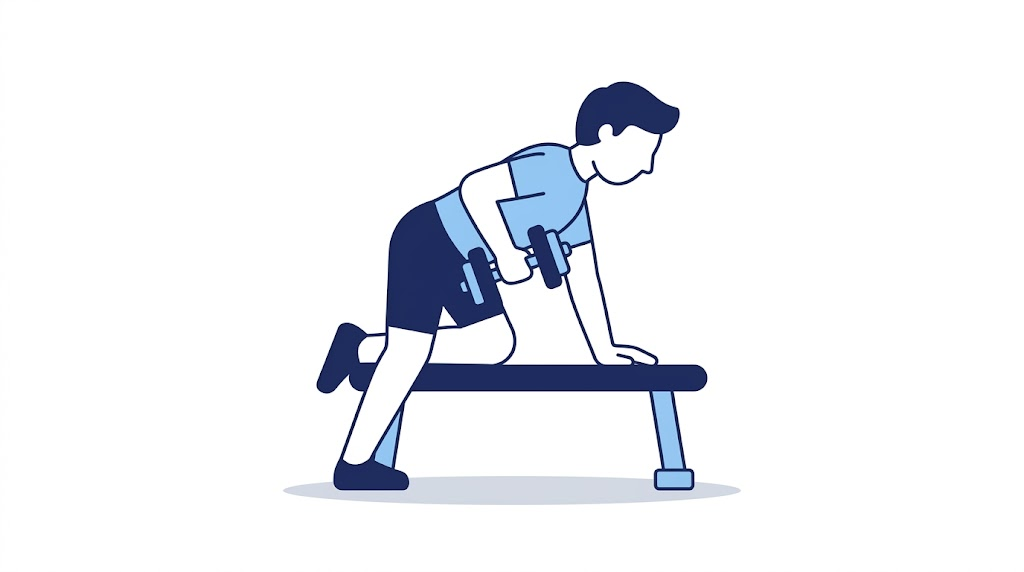
Almost every muscle-building question comes back to the same four levers. Each one has research behind it, so you can stop second-guessing and start training.
1. Weekly Sets: What the Research Shows
A systematic review and meta-analysis by Schoenfeld, Ogborn and Krieger pooled 15 studies (34 treatment groups) and found a clear dose-response relationship. Each additional weekly set per muscle was linked to roughly a 0.37% increase in muscle growth, and groups doing 10 or more weekly sets per muscle outperformed groups doing fewer than 5.
A newer 67-study meta-regression covering 2,058 participants, currently a preprint and not yet peer-reviewed, points the same way. It reports that more weekly volume increases muscle growth with diminishing returns, while training frequency had a negligible effect on growth once total volume was accounted for. Treat that second finding as promising rather than settled until it’s published.
What to do with this: aim for roughly 9 to 12 hard sets per major muscle group across the week. A hard set means you stop about 1 to 3 reps before you’d fail, the same standard we use in our strength training for beginners guide.
How to count your sets: a set of push-ups counts toward chest, shoulders and triceps. A set of rows counts toward your back and biceps. You don’t need to be exact. Just make sure each major muscle gets a few hard sets in every session.
2. Protein: Where the Benefit Levels Off
Too little protein caps your progress. Eating far more than you need doesn’t raise it much further. Morton and colleagues pooled 49 resistance-training trials in the British Journal of Sports Medicine and found that the benefit of extra protein for muscle gain levelled off at about 1.6 g per kg of bodyweight per day, with the upper end of the estimate near 2.2 g per kg.
For a 70 kg person, 1.6 g per kg is about 112 g of protein a day. Spread it across your meals if that’s easier. You can work out your own target with our protein intake calculator, and our protein guide for beginners covers sources and the kidney-health caveat.
Total food matters too. Eating around maintenance or a small surplus gives your body the material to build with. This article stays focused on training, so for calories and eating more to gain size, see our guide on how to gain weight fast.
3. Progressive Overload: The Engine
Your body adapts to a stimulus and then stops responding to it. To keep growing, the stimulus has to increase. That doesn’t always mean heavier weights. You can add a rep, add a set, slow the lowering phase, or shorten your rest. Our guide to progressive overload at home shows how to do this without a full gym.
The simplest rule for beginners is double progression. Pick a rep range such as 8 to 12. When you hit 12 clean reps on every set, raise the weight or move to a harder variation, then start again at 8.
4. Sleep and Recovery
Training is the signal, and recovery is when your body responds to it. Consistently short sleep makes hard sessions feel worse and recovery slower. Adults are generally advised to get at least 7 hours a night, so if you’re training hard and not progressing, sleep is one of the first things to check.
Rest days count as part of the program, not a break from it. If you’re unsure how many you need, see how many rest days you should have.
What Doesn’t Speed Up Muscle Growth (As Much As You’d Think)
| Popular tactic | What actually happens |
|---|---|
| Training every muscle daily | Frequency matters little once weekly volume is matched |
| Chasing extreme soreness | Soreness reflects unfamiliar training, not how much you’re growing |
| Constantly changing exercises | Repeating and progressing the same lifts beats constant variety |
| Expensive supplements | Training and total protein intake do the heavy lifting |
| “Muscle confusion” | Progressive overload works; randomness doesn’t |
If you’re often very sore, our post on muscle soreness after a workout explains what’s normal.
Pick Exercises That Work Several Muscles at Once
Beginners get the most from compound moves such as squats, rows, presses and hinges, because each one trains several muscle groups in a single set. That makes it far easier to reach your weekly set target without spending two hours in the gym. Isolation moves like curls and lateral raises are a useful extra once the basics are in place. Every exercise in the plan below is a compound move.
Start every session with a few lighter warm-up sets of your first exercise. Then focus on smooth, controlled reps through a full range of motion. Good form keeps the tension on the muscle and keeps your joints happy.
A 3-Day Beginner Plan You Can Do at Home
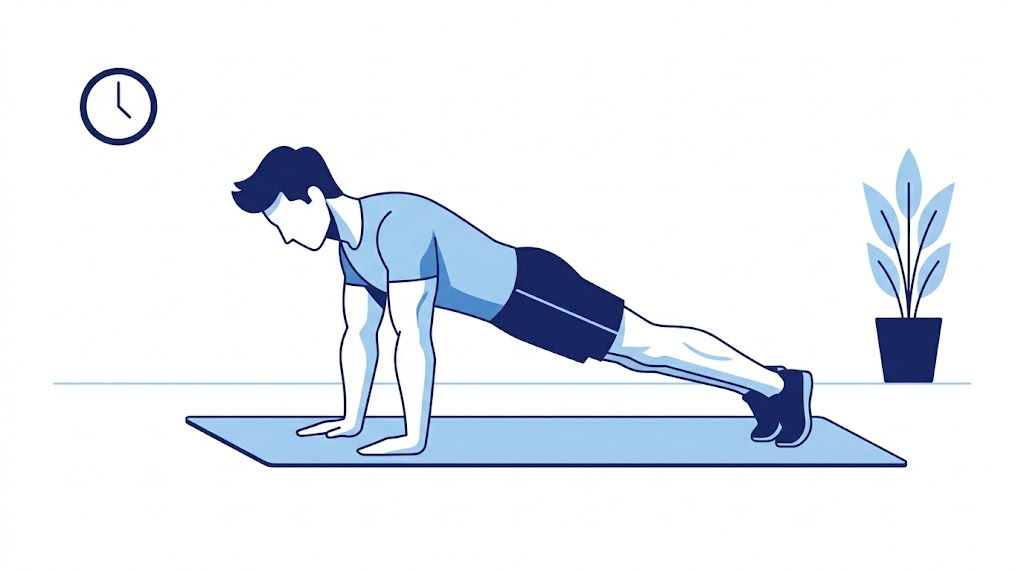
This full-body plan hits every major muscle group three times a week using basic equipment. Rest at least one day between sessions (Monday, Wednesday and Friday works well).
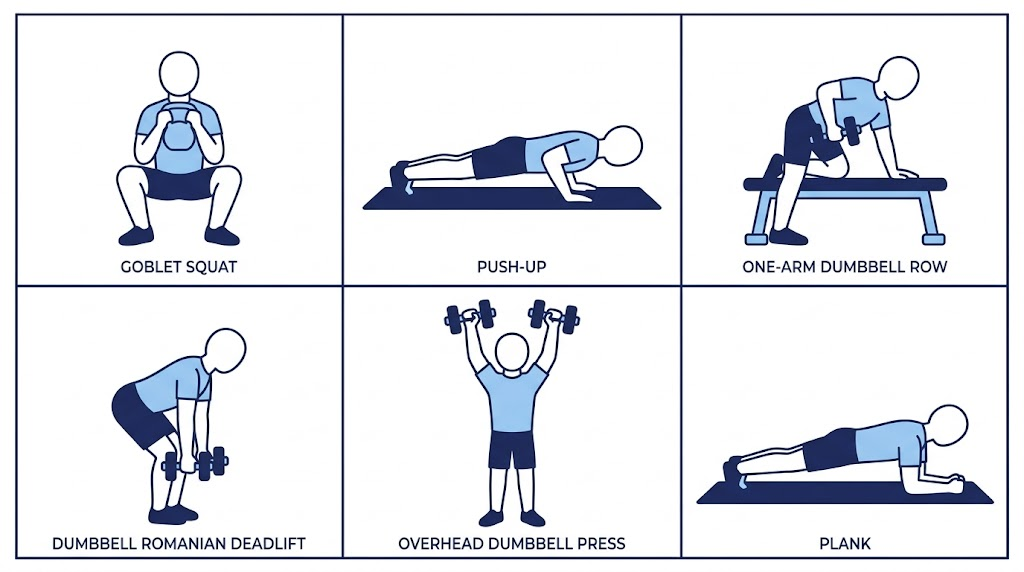
Each session (2 to 3 sets per exercise, 8 to 12 reps, stopping 1 to 3 reps before failure):
- Goblet squat or bodyweight squat (legs)
- Push-up or dumbbell floor press (chest, triceps)
- One-arm dumbbell row (back, biceps)
- Dumbbell Romanian deadlift (hamstrings, glutes)
- Overhead press with dumbbells or bands (shoulders)
- Plank, 3 sets of 30 seconds (core)
Need ideas for more moves? See our dumbbell exercises for beginners and resistance bands for beginners guides. If you have a doorway bar, our at-home back workout with a pull-up bar shows how to use it.
Progress is easy to miss week to week, so tracking is what keeps you honest. A notebook or a notes app is enough, and comparing this week’s numbers with last month’s will tell you far more than the mirror will.
Write down your reps each session. If the numbers aren’t slowly climbing over a few weeks, adjust food, sleep or effort before you change the program.
Recommended Equipment for Building Muscle at Home
You don’t need much. These four items cover almost everything in the plan above:
- Adjustable dumbbells: the most useful tool for progressive overload at home, since you can add weight in small steps.
- Resistance band set: cheap, portable and good for rows, presses and extra volume.
- Doorway pull-up bar: the best home option for building your back and biceps. Our pull-up bar buying guide explains which type suits your space.
- Whey protein powder: a convenient way to reach your protein target, though food works just as well.
Common Mistakes That Slow Beginners Down
- Changing programs every two weeks. Progress needs repetition.
- Never pushing close to failure. If every set feels easy, the stimulus is too low.
- Ignoring protein. Training without enough of it leaves gains on the table.
- Skipping sleep and rest days. Recovery is where the response happens.
- Comparing yourself to advanced lifters. They started where you are.
Final Thoughts
Knowing how to build muscle fast comes down to doing the unglamorous things consistently: enough weekly sets, enough protein, small steady increases, and enough sleep. The research behind each one is solid. The shortcut is removing the mistakes, not finding a secret. Start with the plan above, track your reps, eat enough protein, sleep well, and give it a few consistent weeks before you judge the result.
Disclaimer & Affiliate Disclosure
This article is for informational purposes only and should not be taken as medical advice. Always consult with a qualified healthcare provider or certified fitness professional before starting or changing your diet or exercise routine. This article may also contain affiliate links. If you purchase through these links, we may earn a small commission at no extra cost to you.