The dosage of creatine for beginners is simple: 3 to 5 grams of creatine monohydrate a day is enough for most healthy adults, taken every day, including rest days. You don’t need a loading phase, special timing or an expensive blend. Creatine is one of the most studied sports supplements in the world, and the position of the International Society of Sports Nutrition is that it’s safe and well tolerated in healthy people. That said, it isn’t for everyone, so this guide also covers who should check with a doctor first.
Table of Contents
Quick Summary
- Dose: 3 to 5 g of creatine monohydrate per day. Larger athletes may use more, but beginners rarely need to.
- Loading is optional. A short loading phase fills your stores faster, but you get to the same place without it.
- Type: creatine monohydrate is the best-studied form. You don’t need fancy versions.
- Safety: research in healthy adults has not found kidney damage at recommended doses. People with kidney disease should talk to a doctor first.
- Expect patience: without loading, your muscles take around three to four weeks to fill up.
What Is Creatine and Does It Work?
Creatine is a compound your body makes and also gets from foods like meat and fish. Your muscles use it to produce quick bursts of energy during heavy lifting and sprinting. Taking a supplement raises the amount stored in your muscles, which can help you do a little more work in each session.
The International Society of Sports Nutrition (ISSN) reviewed the evidence in a 2017 position stand and concluded that creatine monohydrate is the most effective supplement available for improving high-intensity exercise capacity and lean body mass gains during training. In plain terms, it helps you train harder, which over time helps you build more muscle. It doesn’t build muscle on its own, so it works best alongside a good strength training routine and enough protein.
Dosage of Creatine for Beginners: How Much Should You Take?
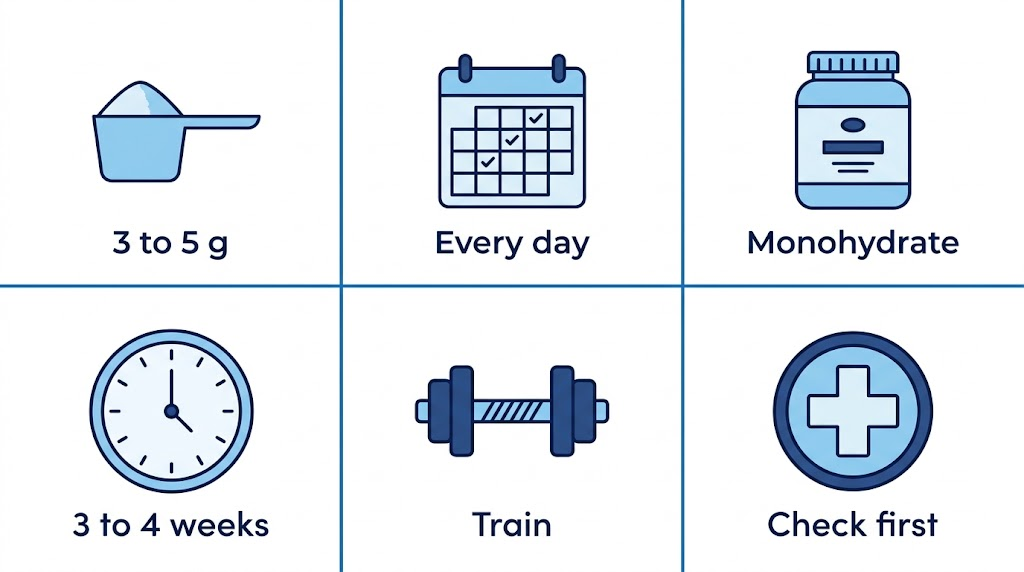
The ISSN recommends a maintenance dose of 3 to 5 grams per day, and notes that some larger athletes may need more. For a beginner, the practical answer is:
- Start with 3 to 5 g of creatine monohydrate per day. One level scoop of most powders is about 5 g, but check the label.
- Take it every day, including rest days. Creatine works by building up in your muscles, not by giving you an instant boost.
- Don’t take more expecting faster results. Your muscles can only store so much, so a bigger scoop won’t speed things up.
A 2021 review of creatine myths from the same research community noted that smaller daily doses of 3 to 5 g (or about 0.1 g per kg of body weight) are effective, so a loading phase is not required. If you prefer a bodyweight-based number, that works out to about 7 g for a 70 kg person, slightly above the 3 to 5 g range, so 5 g is a sensible starting point for most beginners and you don’t need to be exact.
Do You Need to Load Creatine?
Loading means taking a higher dose for a short time to fill your muscles faster. The ISSN describes loading as about 0.3 g per kg of body weight per day, split into four doses, for five to seven days, followed by the normal maintenance dose. For a 70 kg person that’s around 21 g a day.
You don’t have to do it. The U.S. National Institutes of Health notes that taking about 3 to 6 g per day without loading will still saturate your muscles in roughly three to four weeks. Skipping the load is simpler, cheaper and avoids taking large doses. Load only if you want faster results and are comfortable splitting the dose across the day.
When Should You Take It?
There’s no strong evidence that exact timing matters for beginners. The best time is whenever you’ll remember to take it every day. Many people mix it into a morning drink or a post-workout shake. Some people find it sits better on the stomach with a meal or a protein shake.
Which Type of Creatine Should You Buy?
Stick with plain creatine monohydrate. The ISSN found that no other form has been shown to be better than monohydrate at raising muscle creatine, and monohydrate has by far the largest body of research behind it. A powder is usually cheaper per serving than capsules or gummies. Look for a product that lists only creatine monohydrate as the ingredient. Many brands also carry third-party testing seals, which are worth checking.
Is Creatine Safe? Common Concerns Answered

Will Creatine Damage Your Kidneys?
In healthy people, research hasn’t found kidney damage at recommended doses. The ISSN found no clinically significant differences in kidney markers between creatine users and controls, and concluded that short- and long-term supplementation is safe and well tolerated in healthy individuals. Older reports raised concerns about people who already have kidney conditions, so if you have kidney disease, speak to your doctor before taking creatine.
Also tell your doctor you take creatine before any blood test. Creatine is converted to creatinine in the body, and creatinine is a marker doctors use to check kidney function, so your reading could look different.
Does Creatine Cause Hair Loss?
This myth traces back to one small 2009 study of 20 rugby players. After a loading phase, their levels of dihydrotestosterone (DHT), a hormone linked to hair loss in people who are genetically prone to it, were about 56% higher, and about 40% above baseline during maintenance. Hair itself wasn’t measured. The 2021 review notes that these results haven’t been replicated and that no study has reported hair loss or baldness in humans from creatine.
The honest summary is that there’s no direct evidence creatine causes hair loss, but the DHT finding is why some people choose to be cautious. If hair loss runs in your family and it worries you, that’s a personal call.
Does Creatine Cause Cramps or Dehydration?
The ISSN found no evidence that creatine causes dehydration or muscle cramps, and the 2021 review reaches the same conclusion. Drink water normally, as you would while training.
Will You Gain Water Weight?
Possibly a little. Creatine can pull water into your muscle cells in the first weeks, which may show as a small rise on the scale. Longer-term studies found it doesn’t change total body water. This is water inside the muscle, not a puffy or bloated look, and it isn’t fat.
Who Should Talk to a Doctor First?
Check with a doctor or pharmacist before taking creatine if any of these apply:
- You have kidney disease or any kidney concern.
- You take prescription medication, especially anything that affects the kidneys.
- You are pregnant or breastfeeding, since there isn’t enough guidance to say either way.
- You are under 18. A 2021 review of creatine in adolescents found monohydrate appears safe in the studies so far but noted that direct safety data in young people is limited, and suggested use only in supervised, serious training. If that’s you, talk to a doctor or parent first.
A Simple 4-Week Creatine Plan for Beginners
- Week 1: Take 3 to 5 g daily with a meal or shake. Keep your usual training routine.
- Weeks 2 to 3: Keep taking it every day, including rest days. Track your lifts, since creatine works alongside progressive overload. Our guide to progressive overload at home explains how to keep adding reps or weight.
- Week 4: Your muscles should now be saturated. Check whether your last few reps feel a little stronger.
- After week 4: Keep taking your daily dose for as long as you’re training consistently.
Remember, creatine is a supplement, not a shortcut. Get your food and training sorted first. Use our protein intake calculator and see how much protein beginners need. Our post on how to build muscle fast covers the training variables that matter most.
Common Creatine Mistakes
- Skipping days. Creatine works through daily buildup, so consistency matters more than timing.
- Overdoing the dose. Your muscles can only store so much.
- Expecting instant results. Without loading, allow three to four weeks.
- Buying expensive blends. Plain monohydrate is the best-studied option.
- Ignoring food and training. Creatine can’t replace a good routine.
Recommended Products for Beginners
- Creatine monohydrate powder: plain monohydrate, the most studied form.
- Whey protein powder: a convenient way to reach your daily protein target alongside creatine.
- Adjustable dumbbells: creatine helps most when you train with progressive resistance. See our full-body dumbbell workout at home.
Final Thoughts
Now you know the dosage of creatine for beginners: 3 to 5 grams of monohydrate a day, taken consistently, with or without a loading phase. Pair it with solid training and enough protein, be patient for a few weeks, and speak to a doctor first if you have kidney issues, take medication or are under 18. Pick a scoop, set a daily reminder and give it a full month before you judge the result.
Disclaimer & Affiliate Disclosure
This article is for informational purposes only and should not be taken as medical advice. Always consult with a qualified healthcare provider or certified fitness professional before starting or changing your diet or exercise routine. This article may also contain affiliate links. If you purchase through these links, we may earn a small commission at no extra cost to you.