Table of Contents
Quick Answer: The 4-Week Beginner Ab Roller Schedule
A safe ab roller workout schedule for beginners runs 2 sessions per week for 4 weeks, progressing from wall-blocked rollouts and plank holds in Week 1 to short kneeling rollouts, then extended kneeling rollouts, and finally full kneeling rollouts with an isometric hold finisher by Week 4. Before starting Week 1, you need a clean 45 to 60 second forearm plank with no hip sagging — this proves your core can brace against the anti-extension demand the ab roller places on your lower back.
Why the Ab Roller Is the Ultimate Anti-Extension Core Tool
Most beginner ab exercises — crunches, sit-ups — train spinal flexion, curling your torso forward. The ab roller trains the opposite skill entirely: anti-extension, keeping your spine rigid and braced while an external force tries to pull it into extension.
This matters because anti-extension strength is what actually protects your lower back during real-world movements — lifting, carrying, bracing under load. A rollout forces your entire anterior chain, from your abs through your hip flexors and lats, to work together to resist that extension force throughout the full range of the movement.
Core stability research supports this distinction directly. Findings referenced by ACE Fitness on anti-extension core training indicate that exercises requiring the spine to resist movement, rather than actively flex it, place meaningfully different demands on the deep stabilizing musculature — training a type of strength that crunches simply don’t address.
Essential Support Gear for Safe Rollouts
| Gear | Joint Protection | Core Resistance | Beginner Value |
|---|---|---|---|
| Ab Roller Wheel | Low — knees need separate padding | High — full anti-extension demand | Essential |
| Thick Knee Mat | High — cushions knees and wrists | None — support only | Highly recommended |
| Resistance Loop Bands | Low | Adjustable — assists the return | Useful for early progression |
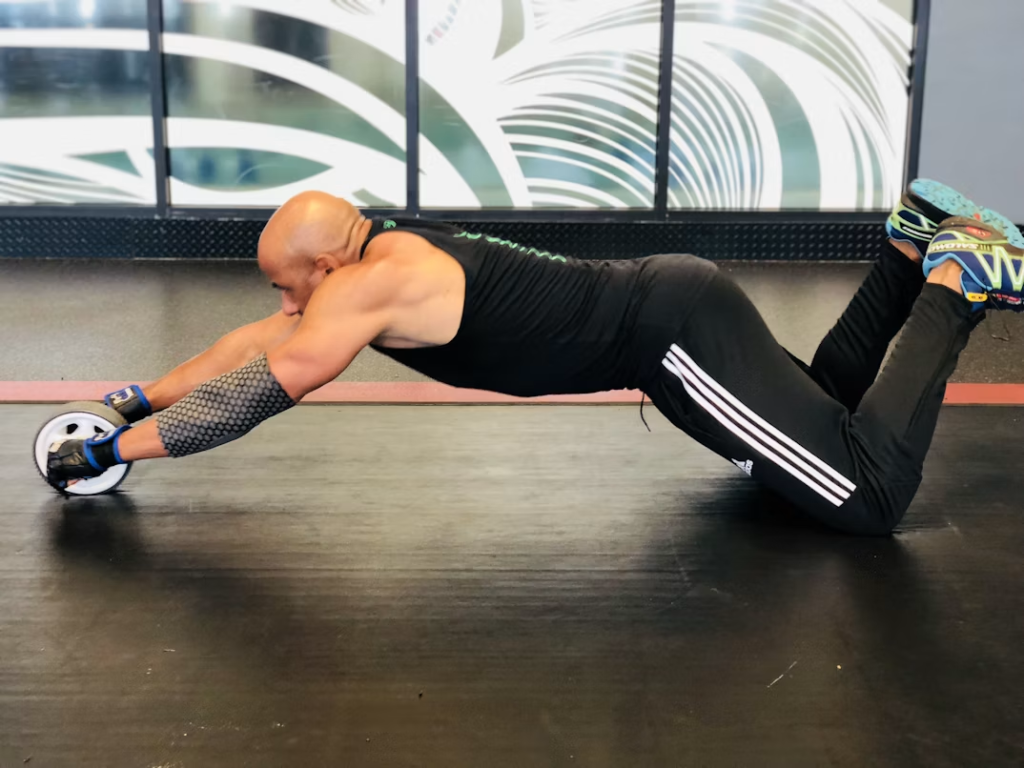
1. Dual-Wheel Ab Roller
To start building anti-extension core strength safely, pick up an ab roller wheel with knee pad on Amazon to maintain solid traction and control.
2. High-Density Knee Cushion Mat
Protect your knees and lower back during kneeling rollouts by using an extra thick exercise mat from Amazon on hardwood floors.
3. Elastic Resistance Bands (Assisted Rollouts)
If you struggle with rollout control, loop a set of resistance loop bands from Amazon around your ab wheel to assist with the return movement.
The Pre-Rollout Assessment: Are You Ready for the Wheel?
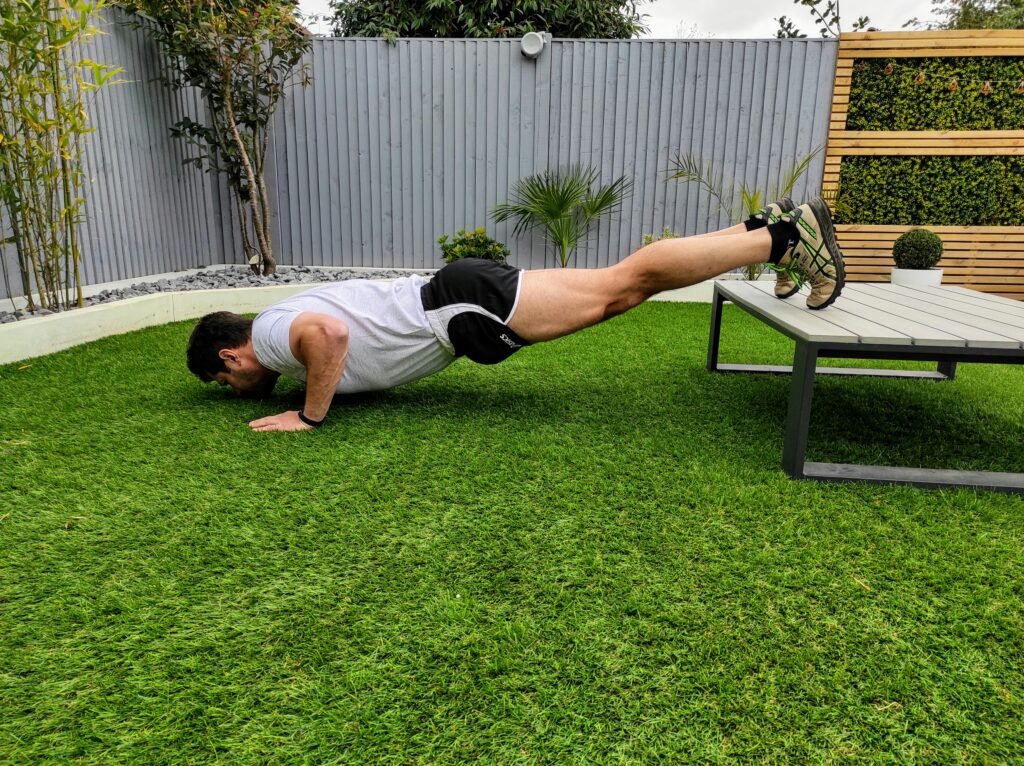
The 45 to 60 Second Forearm Plank Standard. Before attempting a single rollout, you need to hold a clean forearm plank — hips level, no sagging, no piking — for 45 to 60 seconds. This isn’t an arbitrary number; the plank proves your core can already brace against extension under sustained load, which is the exact skill a rollout demands under a much longer lever arm. If you can’t hold this yet, spend one to two weeks building your plank before touching the wheel at all.
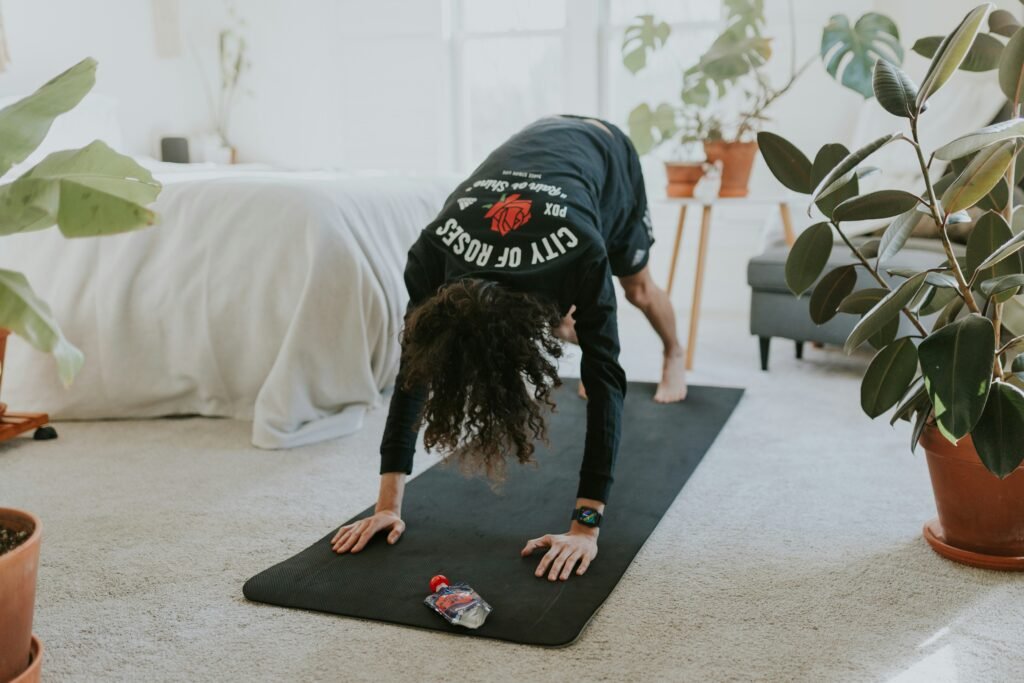
Posterior Pelvic Tilt (PPT) Cueing. Before every rep, tuck your pelvis slightly — imagine flattening your lower back toward the floor. This pre-tensions your abs and is the single most important cue for preventing the lower back from arching as the wheel moves away from you. If you feel your lower back arch at any point during a rollout, that’s your signal you’ve gone further than your current strength allows.

The Complete 4-Week Ab Roller Schedule for Beginners
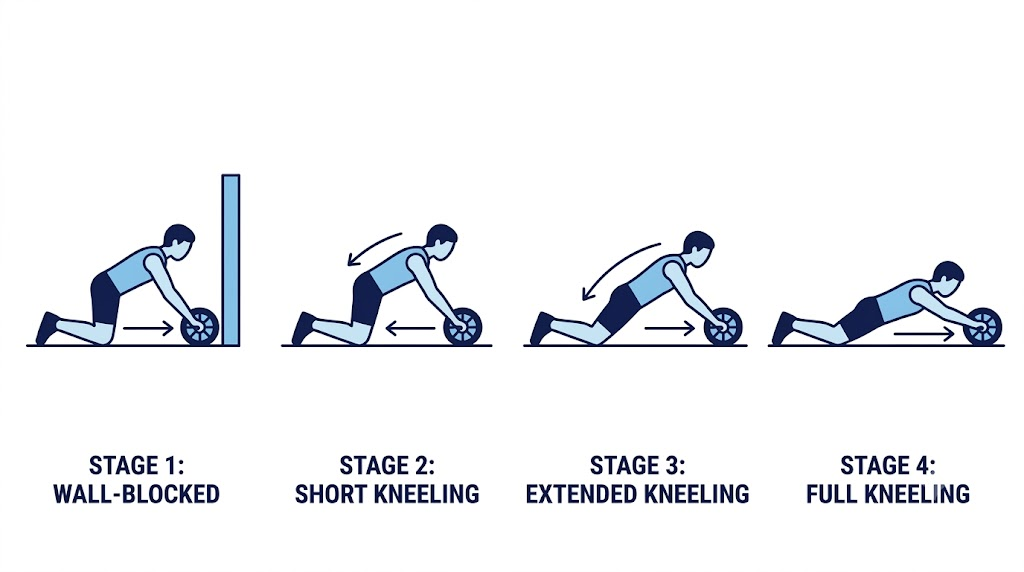
Week 1 — Wall-Blocked Rollouts and Ab Wheel Plank Holds
3 sets of 6 to 8 reps, 2 sessions per week. Position a wall a short distance in front of you so the wheel physically cannot travel past a safe range. This lets you practice the bracing pattern with a hard safety limit while you build confidence.
Week 2 — Short-Range Kneeling Rollouts
3 sets of 8 to 10 reps, 2 sessions per week. Remove the wall and roll out to roughly a quarter of your full potential range, focusing entirely on maintaining the posterior pelvic tilt throughout.
Week 3 — Extended Kneeling Rollouts with Controlled Tempo
3 sets of 10 to 12 reps, 2 sessions per week. Extend your range further — roughly halfway — while slowing your tempo to 3 seconds out and 3 seconds back. The slower tempo increases time under tension without needing more range.
Week 4 — Full Kneeling Rollouts Plus Isometric Hold Finisher
3 sets of 10 to 12 reps, 2 sessions per week. Extend to your full comfortable kneeling range, and finish your final set with a 5 to 10 second isometric hold at your furthest controlled point.
If you want a low-impact cardio session to pair with your core training days, our guide on quiet home workouts gives you a 20-minute apartment-friendly circuit that fits well alongside this schedule.
How to Progress Core Resistance Without Hurting Your Lower Back
Once you’ve completed the 4-week schedule, the same lever-length principle that got you from wall-blocked to full kneeling rollouts continues to work as your ongoing progression tool. Extending your range of motion increases resistance without needing to add any external weight — the further the wheel travels, the longer the lever arm your core has to control.
For a full breakdown of applying progressive overload safely across any bodyweight movement, that guide covers tempo, range, and rest manipulation in detail — all of which transfer directly to ab roller progression.
As your core training expands beyond the wheel, building out a proper minimalist home gym setup gives you the next layer of equipment worth adding to your routine.
Common Beginner Mistakes (and How to Fix Form Instantly)
Arching the lumbar spine. This is the single most common and most injury-relevant mistake. If your lower back arches at any point during the movement, you’ve exceeded your current core strength for that range. Fix: shorten your range immediately and rebuild the posterior pelvic tilt cue from the start of the rep.
Pulling with the arms or hip flexors instead of the abs. Letting your shoulders and hip flexors do the work removes the anti-extension demand entirely and defeats the purpose of the exercise. Fix: focus on initiating the return by contracting your abs first, not by yanking with your arms.
Rolling out too far, too soon. Ego and impatience are the two things most likely to injure a beginner on this movement. Fix: follow the 4-week range progression above exactly as written, even if a further range feels achievable on a good day — consistency in range matters more than occasional maximal reps.
Frequently Asked Questions
Can I do ab roller workouts every single day?
No. Like any resistance exercise, your core muscles need recovery time between sessions to repair and strengthen. Two sessions per week with rest days between is the appropriate frequency for beginners following this 4-week schedule.
Why do my abs hurt or cramp after ab roller exercises?
Mild soreness in the 24 to 48 hours following a session is normal, especially early in the 4-week schedule as your core adapts to a new type of demand. Sharp pain during the movement itself, or any pain in your lower back specifically, is different — that’s a signal to reduce your range and re-check your form, not something to push through.
When should I transition from kneeling to standing rollouts?
Only after you can comfortably complete full-range kneeling rollouts with perfect form and no lower back arching — typically well beyond this initial 4-week schedule. Standing rollouts dramatically increase the lever length and core demand, and rushing this transition is a common cause of injury for intermediate lifters who progress too quickly.
Disclaimer & Affiliate Disclosure
This article is for informational purposes only and should not be taken as medical advice. Always consult with a qualified healthcare provider or certified fitness professional before starting or changing your exercise routine. This article may also contain affiliate links. If you purchase through these links, we may earn a small commission at no extra cost to you.