
Learning how to build endurance comes down to two things most guides get wrong: training slower than feels productive, and progressing by a completely different rule than the one everyone repeats.
Table of Contents
Quick Summary
- Most of your endurance training should happen at a conversational pace — one where you could hold a conversation, not gasp through it. Elite endurance athletes spend roughly 80% of their training at this easy intensity.
- The famous “10% rule” (never increase weekly training volume by more than 10%) is the most commonly repeated injury-prevention advice in endurance training — and a systematic review of the actual evidence found it isn’t well-supported by research at all.
- What actually predicts injury risk better: avoiding a single sudden spike in one session or week relative to your recent pattern — not hitting an exact mathematical percentage.
- Endurance improvements are genuinely measurable within 8-12 weeks of consistent training.
- Consistency at an easy pace beats occasional hard efforts for building your aerobic base.
The Foundation: Training at a Conversational Pace
Here’s something counterintuitive: building endurance mostly requires training easier than most people assume, not harder. This concept — often called training in an aerobic or “conversational” zone — means moving at a pace where you could speak in full sentences, not one that leaves you gasping.
Research on elite endurance athletes found they spend roughly 80% of their training time at this easy intensity, saving harder efforts for a smaller portion of their training. Worth being honest here, though: some of the more specific claims about this training zone circulating in fitness content — that it’s uniquely essential for mitochondrial health, for instance — go further than the current research actually supports. The practical, well-supported takeaway is simpler: most of your training should feel comfortably sustainable, not maximally hard, and that’s what actually builds the aerobic base everything else depends on.
How to Build Endurance Without Getting Hurt

This is genuinely the most useful correction in this whole article. Nearly every endurance guide repeats some version of the “10% rule” — never increase your weekly training volume by more than 10% from the previous week. It’s treated as settled science. It isn’t.
A systematic review examining the actual evidence behind running injury prevention found that a 10% average increase in weekly distance had no meaningful protective effect compared to larger increases, when tested directly in novice runners. One study of 486 novice runners found no difference in injury rates between a standard progression and a 10%-rule progression at all.
What actually seems to matter more: avoiding a sudden spike in a single session or week relative to your recent pattern — not hitting an exact percentage. A runner could technically follow the 10% rule on paper while still doing three easy short sessions and one dramatically longer one in the same week, creating real spike-related risk the weekly-total math never catches. The practical takeaway: progress gradually and consistently, and be especially cautious about any single session that’s dramatically longer or harder than what you’ve recently been doing — not about hitting a specific weekly math formula.
How to Build Endurance: A Simple Beginner Progression
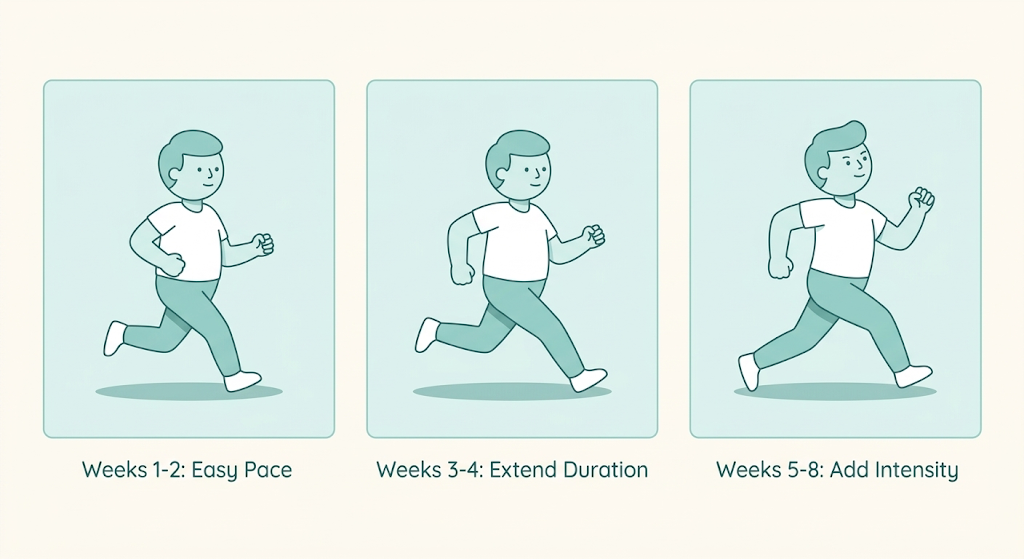
- Weeks 1-2: 20-30 minutes of continuous, conversational-pace activity, 3x per week
- Weeks 3-4: Extend sessions to 30-40 minutes, still at an easy pace
- Weeks 5-8: Introduce one slightly harder session per week, keeping the rest easy
- Throughout: if any single session feels dramatically harder or longer than your recent normal, that’s the moment to be cautious, not a specific weekly percentage
Common Mistakes to Avoid
- Training hard every session. Going all-out constantly actually limits how well your aerobic base develops — easy days need to stay genuinely easy.
- Chasing the 10% rule as a safety guarantee. As the research shows, it doesn’t reliably prevent injury on its own.
- One dramatically bigger session breaking your pattern. This matters more than your weekly total does.
- Expecting fast results. Meaningful endurance improvements generally take 8-12 weeks of consistent training, not days.
Learning how to build endurance isn’t about training harder — it’s about training at the right intensity most of the time, and progressing without any single session becoming a dramatic outlier from your recent pattern. If you’re deciding how cardio fits alongside strength work, our cardio vs weights for beginners guide breaks that down, and our guide on training frequency covers how often to actually train each week.
Disclaimer & Affiliate Disclosure
This article is for informational purposes only and should not be taken as medical advice. Always consult with a qualified healthcare provider or certified fitness professional before starting or changing your diet or exercise routine. This article may also contain affiliate links. If you purchase through these links, we may earn a small commission at no extra cost to you.