Table of Contents
Quick Summary Box
- The answer: 3 to 4 days per week is optimal for most beginners
- Why: Allows roughly 48 hours of recovery between sessions targeting the same muscle groups, while still building consistency
- Track it simply: A free smartphone calendar app or basic notes app handles this — no special equipment needed
How many days a week to workout at home should a beginner aim for? 3 to 4 days per week is the sweet spot for most people just starting out. This frequency gives your muscles roughly 48 hours to recover between sessions targeting the same muscle groups, while still being frequent enough to build genuine long-term consistency and momentum.
Why 3 to 4 Days Is the Sweet Spot for Beginners
Muscle protein synthesis — the process your body uses to repair and build muscle after training — stays elevated for roughly 24 to 48 hours after a session. Training each muscle group within that window, rather than leaving a full week between sessions, keeps this repair process working more consistently across your week.
Your central nervous system needs recovery too, not just your muscles. Beginners especially can underestimate how much CNS fatigue accumulates from learning new movement patterns under load, and 3 to 4 sessions per week with rest days between gives this system genuine recovery time alongside your muscles.
Habit formation matters as much as the physiology. 3 to 4 days a week is frequent enough to build a real routine, but sustainable enough that most people can realistically maintain it long term — which matters more for actual results than a theoretically “optimal” frequency you can’t stick to.
Active Recovery vs. Complete Rest Days

Not every non-training day needs to look the same.
Active recovery days — light walking, gentle stretching, easy mobility work — keep blood flowing to recovering muscles and can genuinely speed up how quickly soreness resolves, without adding meaningful training stress.
Complete rest days are appropriate when you’re managing significant fatigue, illness, or accumulated soreness that active movement wouldn’t meaningfully help. Both types of rest day serve a purpose — the right choice depends on how you’re actually feeling that day, not a rigid schedule.
Essential Home Equipment for Consistent Weekly Workouts
Building a sustainable weekly habit doesn’t require an elaborate setup — a couple of versatile pieces cover most of what a 3 to 4 day routine needs.
Creating a dedicated, comfortable training zone makes showing up consistently genuinely easier. An Amazon Basics Extra Thick Exercise Mat gives you a defined space that signals “training time” and protects your joints across floor-based work.
For progressively challenging your muscles across multiple weekly sessions, a UPOWEX Resistance Bands Set gives you enough resistance variety to keep 3 to 4 sessions a week genuinely challenging as you get stronger.
Tracking which days you’ve trained requires nothing more elaborate than a free smartphone calendar app or a basic notes app — marking off training days is enough to build awareness of your actual consistency without needing a dedicated tracking product.
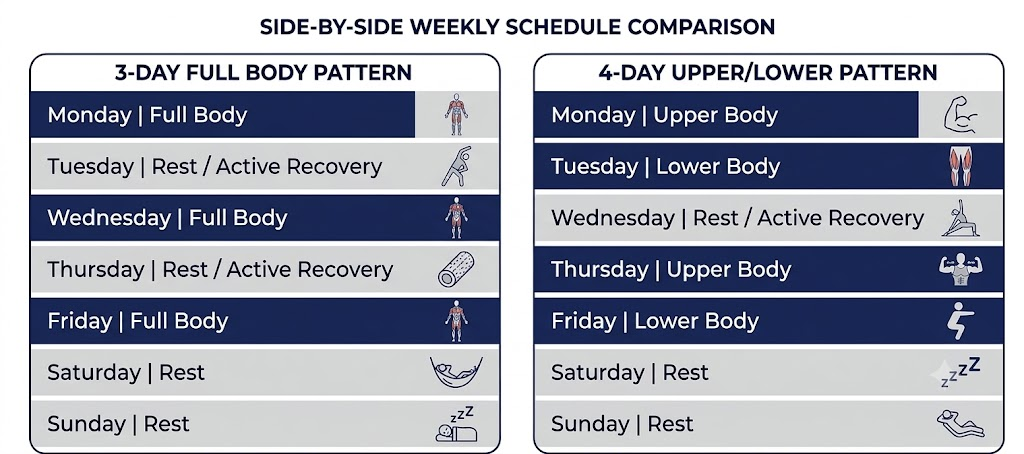
Sample Weekly Schedules

| Day | 3-Day Full Body | 4-Day Upper/Lower |
|---|---|---|
| Monday | Full Body | Upper Body |
| Tuesday | Rest / Active Recovery | Lower Body |
| Wednesday | Full Body | Rest / Active Recovery |
| Thursday | Rest / Active Recovery | Upper Body |
| Friday | Full Body | Lower Body |
| Saturday | Rest | Rest |
| Sunday | Rest | Rest |
For a deeper look at which structure suits your specific goals better, our full body vs split breakdown walks through exactly when each approach makes more sense. And if you want a ready-made routine to plug into either schedule, our 3-day resistance band workout schedule is built for exactly this frequency.
3 Signs You Are Training Too Frequently
Soreness that persists beyond 72 hours. Some muscle soreness is normal, but if it’s consistently lasting three full days or more, your current frequency may not be leaving enough genuine recovery time between sessions.
Declining sleep quality. Overtraining can disrupt sleep through elevated stress hormones and nervous system fatigue — if your sleep is getting worse rather than better as you train more consistently, frequency is worth reconsidering.
A noticeable drop in motivation. If sessions that used to feel manageable now feel like something to dread or avoid, that’s often your body signaling it needs more recovery time than your current schedule allows.
Frequently Asked Questions
Is working out 3 days a week enough to see results?
Yes. Consistent 3-day-a-week training, done with genuine effort and progressive overload over weeks and months, is genuinely sufficient to build meaningful strength and muscle for most beginners — frequency matters less than consistency and effort within each session.
Can I work out every day if I keep workouts short?
It depends on what you’re doing daily. Light, low-intensity movement — walking, gentle mobility work — is generally fine every day. But daily high-intensity or resistance training without any rest days risks accumulating fatigue faster than your body can recover, even if each individual session is short.
Should beginners do cardio on rest days?
Light cardio, like a walk, works well as active recovery and generally doesn’t interfere with your muscles’ recovery from resistance training. More intense cardio on a rest day defeats the purpose of that rest day somewhat — reserve harder cardio efforts for a scheduled training day instead.
What if I miss a scheduled workout day?
Simply pick your routine back up on your next scheduled day rather than trying to cram in a missed session or feeling like the week is ruined. Consistency over months matters far more than any single missed day, and treating one missed session as a minor blip rather than a failure is what actually keeps people training long term.
According to the CDC’s physical activity guidelines, adults should aim for at least 150 minutes of moderate aerobic activity per week alongside muscle-strengthening activities on 2 or more days — a target the 3 to 4 day structures above comfortably meet. The 2026 ACSM Position Stand further supports that beginners can achieve meaningful strength and hypertrophy gains at this frequency, provided weekly volume per muscle group is adequate, as covered in our how long a home workout should last guide.
Disclaimer & Affiliate Disclosure
This article is for informational purposes only and should not be taken as medical advice. Always consult with a qualified healthcare provider or certified fitness professional before starting or changing your exercise routine. This article may also contain affiliate links. If you purchase through these links, we may earn a small commission at no extra cost to you.