Table of Contents
Quick Answer: The Weekly 3-Day Resistance Band Schedule
A complete 3 day resistance band workout schedule trains your entire body across three sessions per week — Monday, Wednesday, Friday — with rest days between each. Day 1 covers upper body push and pull movements for chest, back, and shoulders. Day 2 targets lower body and core through squats, glute bridges, and anti-rotation work. Day 3 combines total-body compound movements to tie everything together. Each session runs 3 to 4 exercises for 3 sets of 8 to 15 reps, taking roughly 30 to 40 minutes.
Why Elastic Resistance Is Ideal for At-Home Strength Building
Resistance bands work fundamentally differently from free weights. A dumbbell provides constant resistance regardless of position — the load feels the same at the top and bottom of a rep. A band provides a progressive tension curve: resistance is lowest at the start of the stretch and increases as the band lengthens, often peaking right where your muscle is mechanically strongest.
A door anchor extends this further, letting a single band replicate the multi-angle loading of a full cable machine — high anchor points for pulldowns, mid-height for presses and rows, low anchor points for squats and curls, all from one piece of equipment that fits in a drawer.
The research backs elastic resistance as a genuine strength-building tool, not just a lighter alternative to weights. A systematic review and meta-analysis published in SAGE Open Medicine examining elastic resistance training against conventional weight training found comparable strength outcomes between the two approaches — meaning bands aren’t a compromise while you wait for a real gym, they’re a legitimate strength-training tool in their own right.

Essential Equipment for a Complete 3-Day Band Split
| Gear | Resistance Range | Target Muscle Groups | Portability |
|---|---|---|---|
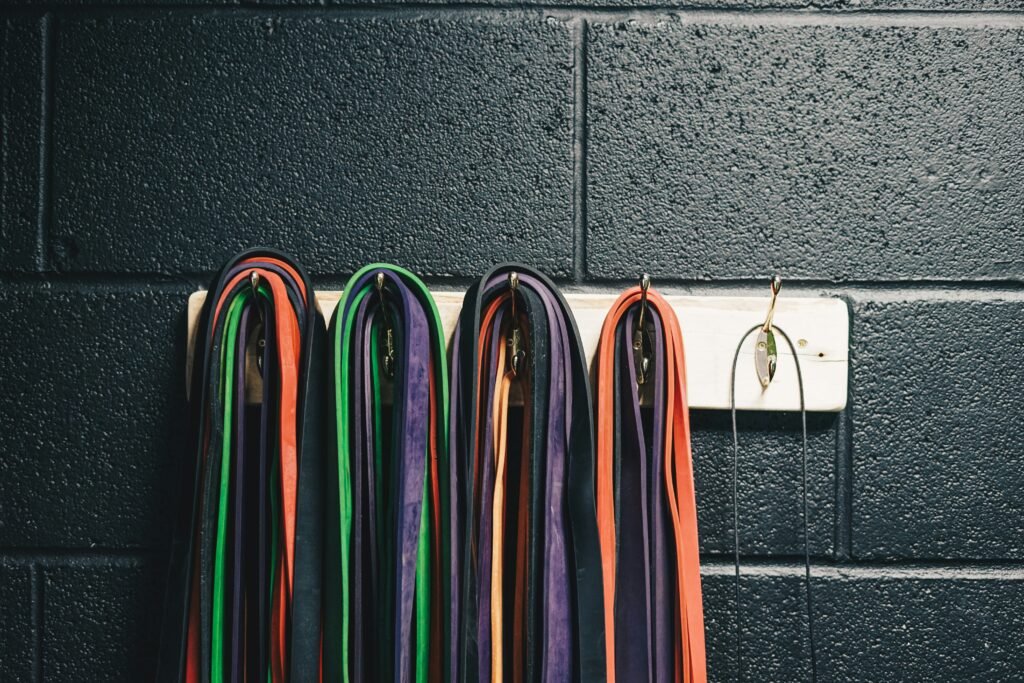
| Tube Band Set with Door Anchor | Adjustable, multi-level | Full body, compound movements | High — packs into a small bag |
| Latex Loop Bands | Light to heavy, fixed per band | Glutes, hips, lower body isolation | Very high — fits in a pocket |
| Folding Exercise Mat | N/A | Joint protection, floor stability | Moderate — folds flat for storage |
1. Multi-Clip Tube Resistance Band Set
To perform heavy compound pushes and pulls at home, set up a tube resistance bands set with door anchor on Amazon to convert any door into a high-versatility cable pulley.
2. Mini Latex Resistance Loop Bands
For targeted glute activation and hip isolation exercises, grab a latex resistance loop bands set on Amazon to add progressive tension to squats and bridges.
3. High-Density Folding Gym Mat
Protect your joints during kneeling anchor drills and floor routines by training on an extra thick folding exercise mat on Amazon.
The Complete 3-Day Resistance Band Routine Breakdown
Day 1 — Upper Body Push and Pull (Chest, Back, Shoulders)
- Banded Door-Anchored Chest Press — 3 sets x 10 to 12 reps
- Standing Resistance Band Seated Row — 3 sets x 12 to 15 reps
- Banded Overhead Shoulder Press — 3 sets x 10 to 12 reps
- Face Pulls with Door Anchor — 3 sets x 15 reps
Day 2 — Lower Body and Core (Quads, Glutes, Hamstrings, Abs)
- Banded Squats or Foot-Anchored Front Squats — 3 sets x 10 to 12 reps
- Loop Band Glute Bridges — 3 sets x 15 reps
- Standing Banded Romanian Deadlifts — 3 sets x 12 reps
- Anchored Band Anti-Rotation Pallof Press — 3 sets x 10 reps per side, focusing on resisting rotation as the band pulls you sideways
Day 3 — Total-Body Compound Strength
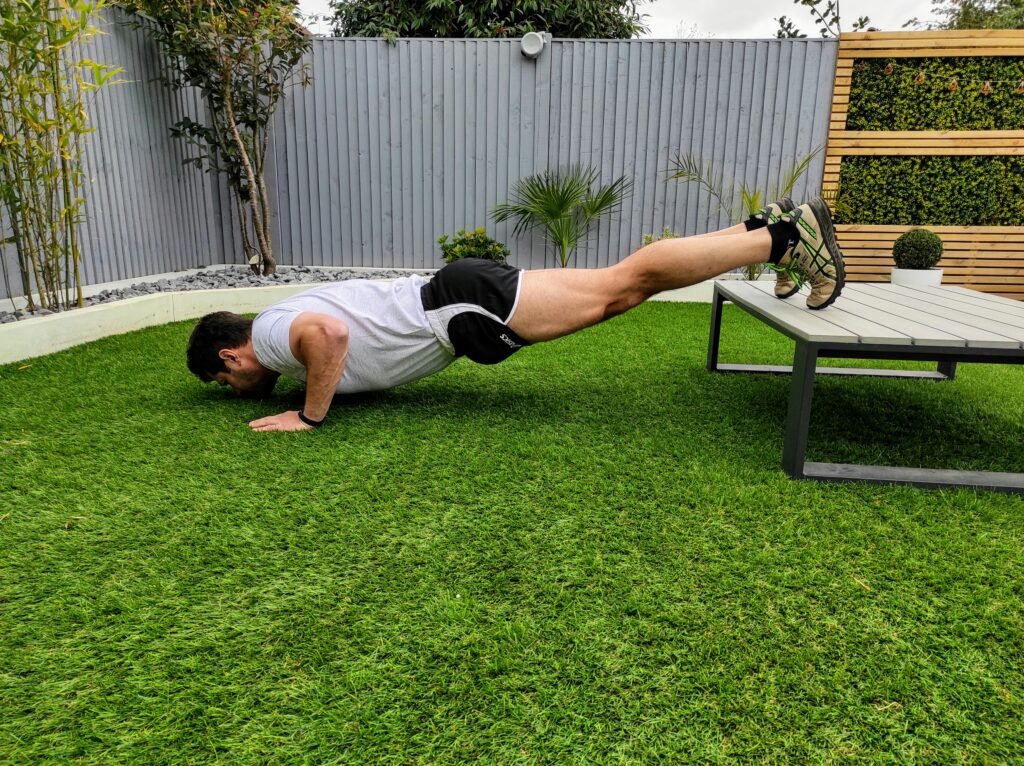
- Banded Push-Up Progressions — 3 sets x 8 to 10 reps
- Lat Pulldowns via High Door Anchor — 3 sets x 12 reps
- Standing Banded Bicep Curl to Overhead Extension Superset — 3 sets x 12 reps
- Banded Plank Holds — 3 sets x 30 seconds, using the anchored band as an isometric anti-extension challenge rather than the rotational focus from Day 2
For a full breakdown of using bands specifically while away from home, our guide on the travel resistance band workout covers a compact 15-minute version of this same equipment philosophy.

Progressive Overload with Bands: How to Get Stronger Every Week
Bands don’t come with a weight stack, but that doesn’t mean progression stops. Three tools keep this 3-day schedule challenging as you get stronger:
Increasing band tension. Moving to a heavier resistance band, or stacking two bands together, is the most direct way to add load once your current band starts feeling too easy for the full rep range.
Shortening your grip or standing distance. Choking up on the band or standing further from the anchor point increases the stretch and therefore the tension throughout the entire movement, without needing a new piece of equipment.
Controlling eccentric tempo. Slowing the lowering phase of any rep to a 3-second count dramatically increases time under tension and muscle demand using the exact same band you already own.
For a complete breakdown of applying these principles across any home training tool, our guide on progressive overload at home covers tempo, volume, and rest manipulation in detail. And if you’re ready to expand beyond bands into a broader home setup, our minimalist home gym on a budget guide walks through exactly what to add next.
Frequently Asked Questions
Can beginners build muscle using only resistance bands?
Yes. Muscle growth responds to progressive mechanical tension, and bands provide that tension effectively when used with sufficient volume and controlled tempo. The SAGE Open Medicine review referenced above found strength outcomes comparable to conventional weight training, confirming bands are a genuine muscle-building tool, not just a lighter substitute.
How do I attach resistance bands safely to a home door frame?
Feed the anchor’s padded stopper through the gap on the hinge side of the door, close the door completely, and lock it if possible. Always pull-test the anchor with a firm tug before starting your actual set, and check that your door hinges are solid — a door that held fine yesterday isn’t automatically safe today if anything has shifted.
What should I do on my rest days between Day 1, Day 2, and Day 3?
Light movement — a gentle walk or some easy stretching — is generally more helpful for recovery than complete inactivity. Keep any rest-day activity easy enough that it doesn’t add meaningful fatigue before your next scheduled session.
Disclaimer & Affiliate Disclosure
This article is for informational purposes only and should not be taken as medical advice. Always consult with a qualified healthcare provider or certified fitness professional before starting or changing your exercise routine. This article may also contain affiliate links. If you purchase through these links, we may earn a small commission at no extra cost to you.