Table of Contents
Quick Summary Box
- The short answer: Full body is generally better for beginners training 3 days a week, thanks to higher training frequency per muscle group and simpler scheduling
- Splits shine at 4-5 days a week, once you have the time to dedicate more focused volume per muscle group
- Both build muscle effectively when total weekly training volume is matched — the real difference is how that volume gets distributed across your week
Full Body vs Split for beginners, training 3 days a week at home, a full body workout is generally the better structure, since it hits every muscle group more frequently and keeps your schedule simple. A split routine — training different muscle groups on different days — starts to shine once you can commit to 4 or 5 sessions a week, since it allows more focused volume per muscle group in each individual session. Neither is objectively superior; the right choice depends entirely on how many days you can realistically train.
What Is a Full-Body Workout?
A full-body workout trains all your major muscle groups — legs, chest, back, shoulders, core — within a single session, typically 3 times per week with rest days between.
Pros: Higher training frequency per muscle group across the week, simpler to schedule around a busy life, and easier to stay consistent with since missing one session doesn’t mean an entire muscle group goes untrained for a full week.
Cons: Individual sessions can run longer since you’re covering more ground each time, and per-muscle volume within a single session is naturally limited compared to a dedicated split day.
Ideal frequency: 3 sessions per week, with at least one rest day between sessions.
What Is a Split Routine?
A split routine divides your training across different days by muscle group or movement pattern, most commonly as an Upper/Lower split (upper body one day, lower body the next) or a Push/Pull/Legs split (pushing movements, pulling movements, and legs each get a dedicated day).
Pros: More total volume possible per muscle group in a single focused session, and sessions tend to be shorter since you’re covering less ground each time.
Cons: Requires more weekly sessions to hit each muscle group at a reasonable frequency, and missing a day means that specific muscle group goes untrained for longer before its next scheduled session.
Ideal frequency: 4 to 5 sessions per week, structured so each muscle group is trained at least twice.
Side-by-Side Comparison
| Factor | Full Body | Split Routine |
|---|---|---|
| Time Commitment | 3 sessions/week, longer each | 4-5 sessions/week, shorter each |
| Recovery | More frequent, lower per-session fatigue | Less frequent, higher per-session fatigue |
| Learning Curve | Lower — simpler structure | Moderate — more programming to manage |
| Muscle Growth | Strong, when volume is sufficient | Strong, when volume is sufficient |
| Flexibility | High — easy to adjust around a missed day | Lower — a missed day skips a whole muscle group |
Equipment Needs at Home: Why You Don’t Need a Commercial Gym
Neither structure requires a commercial gym setup. Two pieces of equipment cover the movement variety both approaches call for.
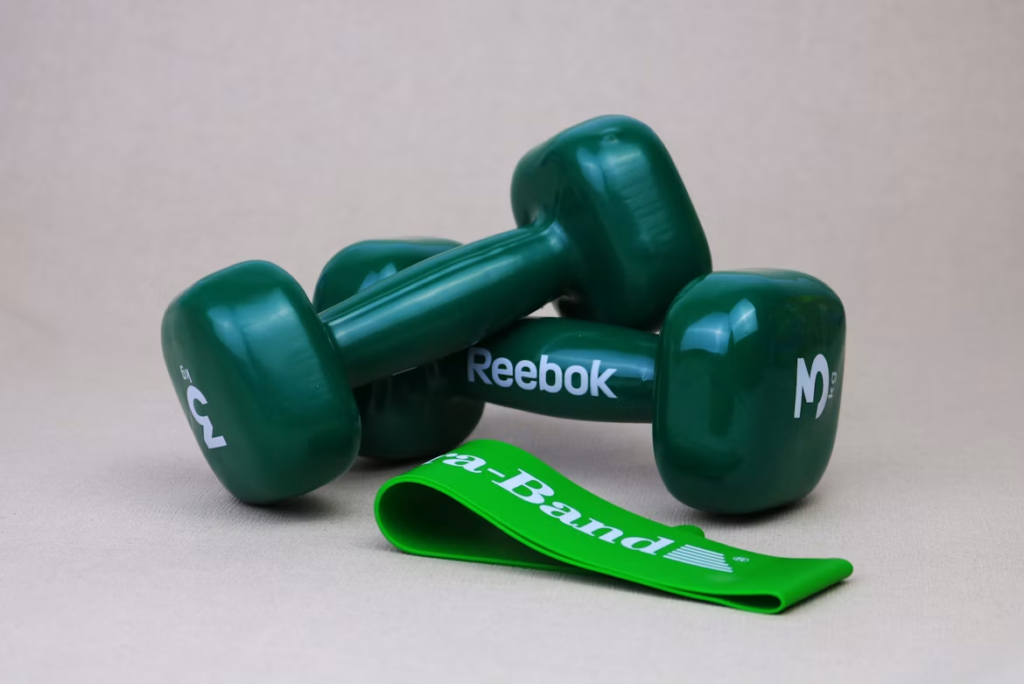
An Adjustable Dumbbell Set covers virtually every muscle group in either a full-body or split structure, scaling weight as you progress without needing a rack of fixed pairs.
A UPOWEX Resistance Bands Set adds progressive overload options and extra pulling movements — particularly useful if you’re structuring a split and need more exercise variety to fill out dedicated push and pull days.
For tracking your sessions, a free smartphone timer or workout log app handles rest periods and progress tracking without needing a physical calendar chart — one less thing to manage on top of your actual training.
Sample Routines: 3-Day Full Body vs 4-Day Upper/Lower Split

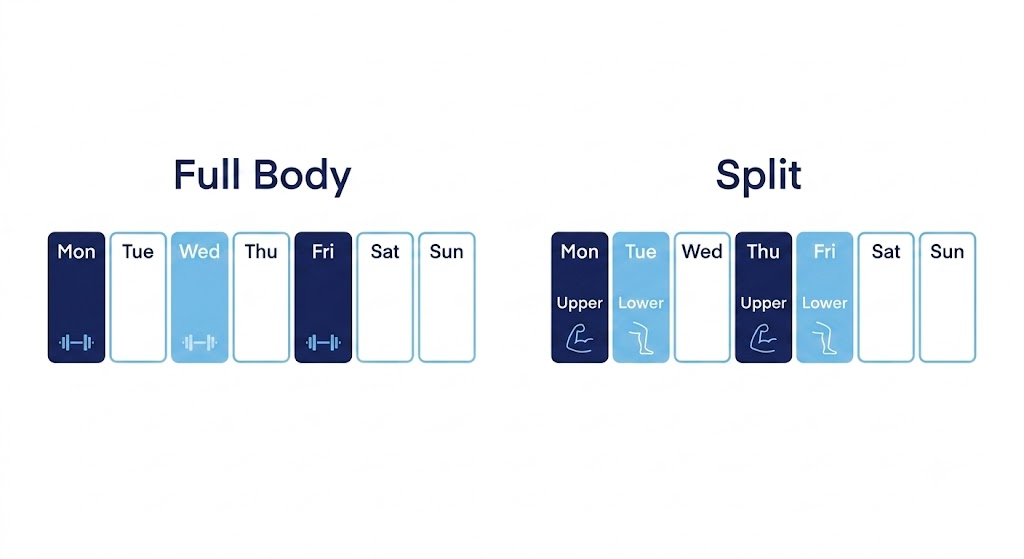
3-Day Full Body (Monday, Wednesday, Friday):
- Squat pattern, press pattern, row pattern, hinge pattern, core — 5 exercises, 3 sets each, every session
4-Day Upper/Lower Split (Monday, Tuesday, Thursday, Friday):
- Day 1 (Upper): Press, row, overhead press, curl — 4 exercises, 3-4 sets each
- Day 2 (Lower): Squat, hinge, lunge, core — 4 exercises, 3-4 sets each
- Day 3 (Upper): Repeat with variation
- Day 4 (Lower): Repeat with variation
Both structures hit each muscle group twice across the week — the full body version through 3 shorter, more frequent sessions, the split version through 4 more focused sessions. Once you’ve settled on your rep and set structure, our reps vs sets breakdown covers exactly how to apply that within either format.
How to Decide: 4 Questions to Find Your Ideal Routine
1. How many days can you realistically train each week? Be honest about your actual schedule, not your ideal one. 3 realistic days beats 5 planned days you consistently skip.
2. Do you prefer longer, less frequent sessions or shorter, more frequent ones? Full body sessions run longer but happen less often. Splits are shorter individually but demand more total weekly sessions.
3. Are you training for general fitness or targeting specific muscle groups? Full body suits general strength and consistency goals well. A split makes more sense if you’re specifically trying to bring up a lagging muscle group with dedicated extra volume.
4. How does your schedule handle a missed session? If missing a day means skipping an entire muscle group for a week under a split, and that’s a realistic risk for your schedule, full body’s flexibility becomes a genuine advantage. Our guide on the best time to work out at home can help you lock in a consistent slot regardless of which structure you choose.
Frequently Asked Questions
Can beginners do a split routine?
Yes, but it requires committing to 4 or more sessions per week to keep each muscle group trained at a reasonable frequency. If your schedule can genuinely support that, a split works fine for beginners — just be honest about whether 4-5 days is realistic before committing.
Is full body 3 days a week enough to build muscle?
Yes. A systematic review and meta-analysis published in the NSCA’s Journal of Strength and Conditioning Research found that when total weekly training volume is equated, full-body and split routines produce broadly similar strength and muscle growth outcomes — meaning 3 well-structured full-body sessions per week is genuinely sufficient for meaningful progress.
Which burns more calories?
The difference is minor and depends more on total session intensity and duration than the specific structure. Full body sessions tend to burn slightly more calories per session since they involve more total muscle groups and movements, but split sessions across the week can match or exceed this when totaled up.
How often should I switch routines?
There’s no need to switch simply for variety’s sake — consistency with a structure that’s still producing progress matters more than novelty. Consider switching only when progress genuinely stalls for several consecutive weeks despite proper effort and progressive overload, or when your available training days change significantly.
For a deeper look at how the current ACSM resistance training guidelines frame frequency and weekly volume recommendations, that position stand covers the broader evidence base both structures in this article are built on.
Disclaimer & Affiliate Disclosure
This article is for informational purposes only and should not be taken as medical advice. Always consult with a qualified healthcare provider or certified fitness professional before starting or changing your exercise routine. This article may also contain affiliate links. If you purchase through these links, we may earn a small commission at no extra cost to you.